What does a city's Chief Digital Officer actually do now that AI has arrived?
Munich, Berlin, Hamburg and Amsterdam built AI assistants for their staff; New York switched off a business chatbot that reporters and its own auditors had found unreliable. Behind both stories is one job, the city's digital chief, now running assistants, keeping registers and steering a legal clock, while few cities can yet show what their AI has changed.

The job before the chatbot
On 25 August 2017, London appointed its first Chief Digital Officer. The notes to the press release set out the job: lead the digital transformation of the capital’s public services, convene London’s councils behind “technology and data-led” service delivery, and build partnerships with business and community groups. Artificial intelligence does not appear.
A year later in Barcelona, Francesca Bria, the city’s Chief Technology and Digital Innovation Officer, described a plan that committed 70% of the budget for new services to free and open-source software. She wanted the move to free software to outlast her government.
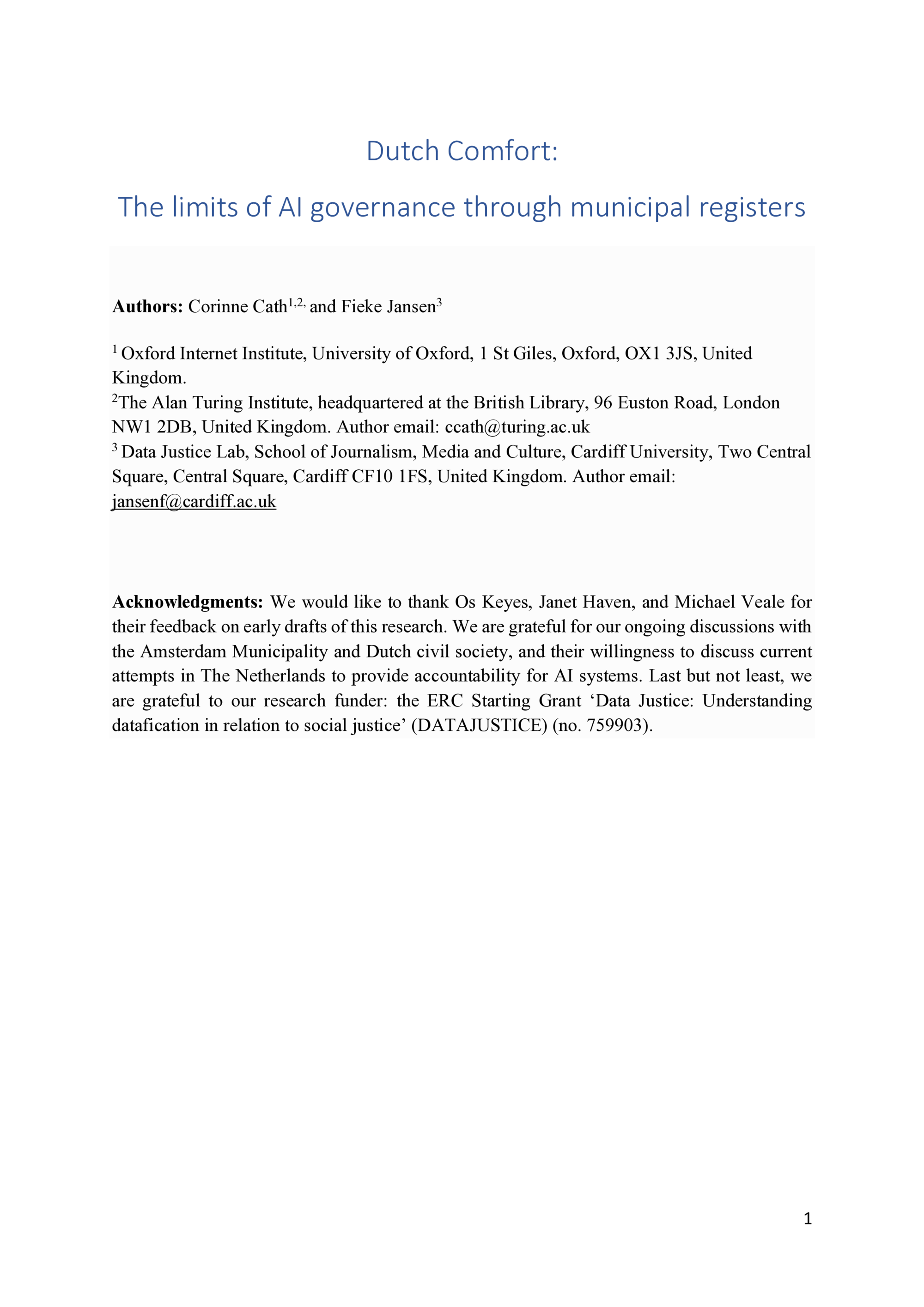
…such decisions should not depend on one person, or on the political orientation of one government.Governing algorithms was then a small, voluntary affair. Amsterdam and Helsinki opened the first city registers of algorithms in September 2020. A year on, two researchers counted eight entries between them: five in Helsinki, mostly chatbots, and three in Amsterdam. In Dutch Comfort they warned that registers risked becoming “ethics theater”, given the proven dangers of such systems in the digital welfare state.
The two pioneers have since gone different ways. Compare what each listed then with what it lists today.
Entries in the first two city registers. Amsterdam’s 2026 figure counts its entries in the Dutch national register, which lists all algorithms, not only AI; Helsinki’s is its own AI register: eight chatbots, one of them retired, and a library logistics system. Source: Cath & Jansen (2021) for 2021; Algoritmeregister dashboard (algoritmes.overheid.nl/nl/dashboard) and City of Helsinki AI Register (ai.hel.fi/en/ai-register) for 2 October 2026
Amsterdam’s climb was gradual: 29 entries in 2023, 40 in early 2024 and 72 today. Helsinki’s still holds no generative AI. Strategy has moved more slowly. A Fraunhofer IESE review of the 23 cities from the United States, Germany, Spain, Austria and the Netherlands in the IMD Smart City Index found a stand-alone AI strategy in only five of them: Vienna, Barcelona, Madrid, New York and Amsterdam (its summary slide says six). None of the five German cities had one, Munich included. In Germany’s Zukunftsradar survey of 1,067 municipalities, most of them small, four had an AI strategy and 57% had no digitalisation officer or CDO.

Much of the old job remains. When Munich’s mayor gave the city’s CDO “far-reaching powers” in August 2026, three of the four first aims were pre-AI work: standard solutions instead of one-offs, digital sign-off instead of paper, and electronic files across the city by the end of 2028. The fourth was AI that answers recurring enquiries on the city’s request forms.
That is the desk generative AI landed on. Since 2023 it has taken on three new jobs without shedding the old ones: running an assistant for tens of thousands of staff, keeping a public account of the algorithms the city uses, and steering the city through the EU’s AI law. The rest of this read takes them in turn, and asks who answers when the machine is wrong.
Everyone got an assistant: build, buy or share
In Munich, city staff draft emails, summarise long documents and brainstorm with MUCGPT, an assistant the city built itself. It went live in March 2024; more than 15,000 of the city’s roughly 40,000 staff now use it regularly, and it handles over 10,000 chats a day, the city says.
Berlin’s Senate Chancellery switched on BärGPT on 25 November 2025. CityLAB Berlin built it as open source, testing it with administrative staff, and it can search Parla, the archive of the city parliament’s written questions. Its makers count over 17,000 users since launch, and the tool is still in trial operation. Hamburg developed LLMoin with the public IT provider Dataport from mid-2023 and, after a staged rollout, made it available to about 40,000 staff, an administration of about Munich’s size; we found no published count of how many use it. Amsterdam’s ChatAmsterdam started as a pilot with 800 officials. Each city counts something different, access, users or regular users, so the figures cannot be ranked against each other.
Seen in order, the wave took less than two years, from Munich’s launch to Hamburg’s whole administration.
- Mar 2024[source]
Munich’s MUCGPT goes live
- Nov 2024 – May 2025[source]
Amsterdam pilots ChatAmsterdam
800 staff in the pilot; over 34,000 prompts.
- Mar 2025[source]
Barcelona announces Copilot
For some 500 municipal staff during 2025 (announced; outcome not published).
- 1 Jul 2025[source]
Vienna issues its KI-Kompass 3.0
Rules for using public AI tools instead of a city-built assistant.
- 25 Nov 2025[source]
Berlin switches on BärGPT
Over 17,000 users since launch; trial operation.
- 15 Dec 2025[source]
Hamburg completes LLMoin’s rollout
Available to about 40,000 staff.
- 30 Jun 2026[source]
MUCGPT 2.0
More than 15,000 regular users.
Each entry says what its number counts. Access, users, regular users and pilot participants are different measures.
Hamburg’s CDO now describes the assistant as office equipment.
AI applications are increasingly becoming part of how we work every day, comparable to established tools for email or scheduling.Behind the numbers sit different choices. Munich and Berlin built on open-source code and publish it; Hamburg built with its public IT provider; in Sweden, Sundsvall and Ånge built Eneo, an open platform anyone can run. Amsterdam built its own assistant but hosts it on Microsoft’s Azure cloud, where staff choose between OpenAI’s GPT 5.5 and Mistral Large 3. Alexander Scholtes, then the alderman for ICT, said in May 2025 that by developing and managing its own AI tools, the city keeps control over its data. An early study of 150 pilot users judged roughly one prompt in fourteen risky, because it held personal data or a statement about a decision, so the city added a filter of its own on top of Microsoft’s.
Other cities bought or wrote rules. Barcelona announced in March 2025 that some 500 staff would get Microsoft’s Copilot that year, and that the council’s AI infrastructure would move to the Microsoft cloud by mid-year; we could not confirm how the rollout went. Vienna chose rules over a tool: its staff compass allows public generative AI tools for work, but only with public data; restricted and confidential material may go only into the city’s internal platform, cleared for now after a data-protection assessment.
We found no independent evaluation, published by any of these cities, of what its assistant changed: time saved, errors made, or what residents noticed. Hamburg’s best evidence is an October 2025 poll in which over 80% of the users asked were satisfied or positive about it; the city calls the sample representative but has not published its size.
When the machine gives the wrong answer
The most thorough public test of a city chatbot we found is American. New York launched its MyCity chatbot in September 2023 to answer business owners’ questions about city rules. In 2024 The Markup and THE CITY found it telling employers they could take a cut of workers’ tips and that businesses could refuse cash, both against city law.
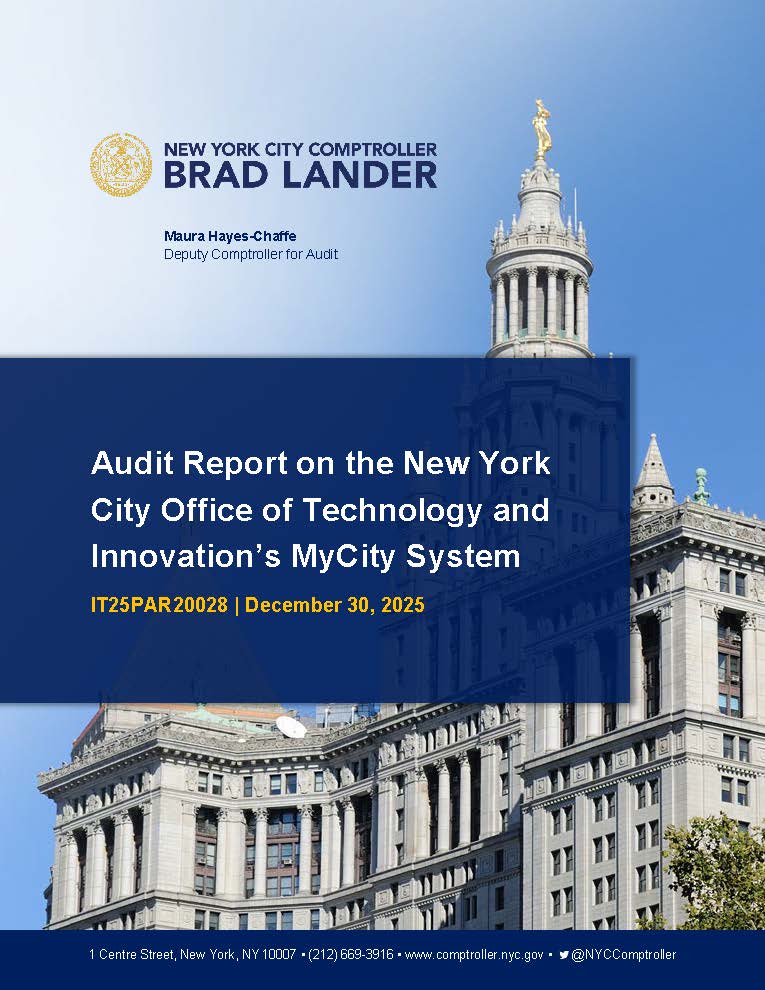
In December 2025 the city’s Comptroller, Brad Lander, published an audit of MyCity. His auditors asked the bot the same question twice and got two different answers. More than 2,200 questions were put to it in July and August 2025; of the 70 users who left feedback, 50, or 71.4%, were negative. Officials at the city’s Office of Technology and Innovation replied that, as a “generative AI”, the information produced “may not always be consistent”.
The office also said the bot was over 95% accurate week to week. The auditors found it had counted prompts recorded rather than questions asked.
- Audit recount, lowest
- Audit recount, highest
- City office’s figure
MyCity chatbot accuracy: the technology office’s claim of over 95% week to week, counted per prompt recorded, against the auditors’ recount for August 2025 per question asked, which gave a range.
And the office’s rate left out answers it had filed under “Room for Improvement”. In January 2026, while looking for budget savings, Mayor Zohran Mamdani called the bot “functionally unusable”, and the city took it down on 4 February.
Europe’s own lesson came from a city that followed the guidebook. Amsterdam’s Smart Check, a model to flag welfare applications for investigation, had bias tests and a human-rights assessment. In its 2023 pilot, nearly 1,600 applications went through it. According to an investigation by MIT Technology Review, Lighthouse Reports and Trouw, bias reappeared and the model was no better than caseworkers at spotting the cases that deserved scrutiny. In late November 2023 the city stopped it.

The city has used all the tools in the responsible-AI tool kit… Nevertheless, the municipality has continued with something that is fundamentally a bad idea.The quietest frontier is the note-taker. In social care in England and Scotland, AI tools transcribe and summarise conversations with the people social workers support; by early 2025 one such tool was in use in 85 local authorities. Swindon’s own pilot, run with the tool’s maker, Beam, with 19 social workers over 184 meetings, reported a 63% cut in the time spent on assessments and case notes. The Ada Lovelace Institute held 39 interviews in 17 local authorities for Scribe and prejudice?. Almost all the social workers said the tools helped, and one council found its records became fuller. But councils judged the tools mainly on efficiency: only two had extended their pilots to check the quality of the records. One of those found the AI often did not raise quality and may have let unchecked hallucinations into official care records. One social worker described a summary that recorded suicidal ideation the client had never mentioned.
Who answers when it is wrong? The individual employee. Amsterdam’s register entry for its assistant says the user “remains responsible for the final content” and any next steps, and the Ada Lovelace Institute found that social workers assume full responsibility for what the transcription tools produce.
So the CDO now owns a new question: how do we know it works? Of the assistants and chatbots in this read, only New York’s has been through an independent audit, and the auditor found it unreliable.
Registers, contracts and the AI Act clock
The Netherlands turned the city register into a national one. When the Algoritmeregister opened in December 2022 it held 109 algorithms; by mid-February 2024 it held 291, with Amsterdam, Utrecht and The Hague contributing the most. It has grown in every month the register’s dashboard shows.
published descriptions
Show the numbers
| All public bodies | |
|---|---|
| Nov 2025 | 1,224 |
| Dec 2025 | 1,306 |
| Jan 2026 | 1,340 |
| Feb 2026 | 1,365 |
| Mar 2026 | 1,397 |
| Apr 2026 | 1,421 |
| May 2026 | 1,441 |
| Jun 2026 | 1,492 |
| Jul 2026 | 1,522 |
| Aug 2026 | 1,538 |
| Sep 2026 | 1,573 |
Published algorithm descriptions in the national Algoritmeregister, month by month to September 2026. Publishing is voluntary, so growth means more listing, not necessarily more AI. Source: Algoritmeregister dashboard, trend table (read 2 October 2026)
By October 2026 the register held 1,573 descriptions from 353 publishing organisations; municipalities supplied 987 of them. Listing is still voluntary. Of 342 municipalities, 208 are listed as publishing, 86 have joined without publishing anything and 48 have not joined at all; the median publishing municipality lists three algorithms. Amsterdam lists more than any other municipality. Elsewhere, Barcelona’s public register of algorithms was, in December 2024, planned but not yet fully implemented, according to a CIDOB case study.
How much a register can miss is clearest one level up. When the Netherlands Court of Audit asked 70 central-government bodies in 2024 what AI they used, they reported 433 systems. Only 5% were in the public register, and for 35% of those in use the organisation did not know whether they did what was expected. That is national government, not cities; we found no comparable count for a city.
Contracts travelled further. The clauses Amsterdam wrote in 2018 for buying algorithmic systems became the basis of the EU’s model contractual clauses for public buyers of AI, published in September 2023 and updated in March 2025 in a full version for high-risk systems and a light one for the rest. Not every buyer asks the question. Among English councils answering the LGA’s 2025 survey, 27% require suppliers to declare whether they use AI, and 25% did not know their own policy.
Then there is the law. The EU AI Act’s literacy duty has applied since 2 February 2025. The AI Omnibus rewrote it: organisations that provide or use AI must now take measures to support the AI literacy of their staff, and the text says this does not require them to guarantee any specific level. AI that public authorities use to evaluate people’s eligibility for essential public benefits and services is classed as high-risk, and before using such a system a public body must assess its impact on fundamental rights and register it in an EU database. Those duties were due in August 2026. The timeline shows where they stand now.
- 1 Aug 2024[source]
The AI Act enters into force
- 2 Feb 2025[source]
AI literacy duty applies
Organisations that deploy AI must take measures on their staff’s AI literacy (Article 4); the Omnibus later rewrote this as supporting literacy, without guaranteeing a level.
- 27 Jul 2026[source]
AI Omnibus in force
Regulation (EU) 2026/1744, published on 24 July, postpones the high-risk deadlines.
- 2 Aug 2026[source]
Transparency duties apply
People must be told when they are dealing with an AI system, and deepfakes must be labelled.
- 2 Dec 2027[source]
High-risk duties for stand-alone systems
Including AI that evaluates eligibility for public benefits: public deployers must assess the impact on fundamental rights and register the system.
Dates as amended by the AI Omnibus, Regulation (EU) 2026/1744.
Until December 2027, then, there is no record of how cities meet the high-risk duties.
A register entry is not an audit. In October 2023, Amsterdam’s own audit office found that the city had “properly examined whether an algorithm is fair” for only one algorithm. Of the five high-risk systems whose documents went into its report, Smart Check was the only one that had also been through a human-rights assessment. A month later, after its own pilot showed bias, the city stopped it.
Who in the town hall knows how?
Every Swedish municipality that answered a survey in autumn 2025 said it used AI in some way. Only 7% said all their staff had received AI training, less than a year after the EU literacy duty began. The duty does not require every employee to be trained, but it does cover everyone who works with an AI system, and in every responding municipality someone did. The survey was run by Akavia, a trade union for graduates; 170 of the 290 municipalities replied. Fewer than one in four had an AI strategy, and a quarter of the smaller ones had offered no AI training at all.

England’s figures come from a different group: heads of IT or senior responsible officers. In February and March 2024, 74 councils answered the Local Government Association. For its 2025 update, 58% of them revised their answers and 30 more councils joined over the winter of 2024–25; the other original answers, about 31, were carried over unchanged, giving 104 responses, a third of councils. Between the two rounds, use rose while the barriers stayed where they were.
Share of responding councils. Use of generative AI and paying suppliers are among councils using or exploring AI (63, then 99); the rest are among all respondents. The 2025 round re-uses about 31 councils’ unchanged 2024 answers and adds 30 new councils, so the two rounds overlap: read the direction, not the size of the change. Source: LGA, State of the sector: AI (2024 and 2025 update)
Funding still tops the list, but the next two barriers are about people.
Germany’s Zukunftsradar asked people in leadership roles, such as mayors and heads of department, and says itself that its results are not representative: 77% thought AI and automated systems sensible in local government, yet 13% used any, and 71% named data protection as a main obstacle. A vendor-backed global panel of 250 cities, run by ThoughtLab with ServiceNow, Deloitte and NVIDIA, found 18% using generative AI widely or selectively in 2024, and shows the AI job sometimes leaving the CDO’s desk: six in ten of its “AI leaders” had appointed a senior head of AI, with a chief AI officer or AI director in New York and Singapore; in Barcelona it names the chief data officer, in Amsterdam the chief technology officer. These surveys asked different people different questions; their numbers cannot be added together.
Some cities are changing who they employ. New York’s new administration announced it would hire public-sector technologists to build its own tools and rely less on outside vendors.
Hamburg, Berlin and Amsterdam paired their assistants with teaching. Hamburg ran training courses on both the tool and basic AI skills alongside LLMoin’s rollout, BärGPT comes with a help centre of video tutorials meant to build staff’s confidence with AI, and Amsterdam says it runs courses and e-learning alongside ChatAmsterdam. We found no published account of what the training changed.
A budget can buy an assistant. On its own it does not supply what England’s next two barriers name: people in the town hall who can judge what an AI system is doing.
Sharing the stack between cities
The pattern we found best documented in Europe is a city that builds once and lets others reuse it. Hamburg offers LLMoin to other administrations through Dataport, and Lower Saxony, Bremen, Saxony-Anhalt and Rhineland-Palatinate have decided to use it. Stuttgart runs Munich’s MUCGPT under the name ChatSTR, and Munich publishes the code and invites other administrations to deploy it. In the Dutch register, the province of Limburg and the municipality of Meierijstad both list GovChat-NL, an open-source platform for Dutch public bodies that each runs under its own name.
Sweden shows why the terms of sharing matter. Sundsvall had made the case more than a year before its split: Sweden’s 290 municipalities have essentially the same mission and needs, it wrote in May 2024, yet each finds its own solutions, which leaves digital welfare unequal; generative AI was a blank sheet on which they could work together. Sundsvall and Ånge had built an AI platform called Intric with private partners. In September 2025 they left it, because a single company controlled the code and kept parts of it closed, and carried on as Eneo under an open licence that any public body or supplier can use and build on.
Follow the tools rather than the cities, and the pattern is easier to see.
- 19 Jan 2023[source]
Eurocities publishes a transparency standard
Built with nine cities on the work of the Amsterdam and Helsinki registers.
- 29 Sep 2023[source]
EU model clauses for buying AI
Based on Amsterdam’s 2018 clauses for algorithmic systems; updated in March 2025.
- Sep 2025[source]
Sundsvall and Ånge relaunch their platform as Eneo
Open source, for any Swedish public body.
- 15 Dec 2025[source]
Hamburg’s LLMoin is available to all staff
Four other German states have decided to use it, through Dataport.
- By Jun 2026[source]
Stuttgart runs Munich’s MUCGPT as ChatSTR
Each entry is a reuse documented by the publisher named; it says nothing about how well the tool works in its second home.
In each case the second user started from working code or tested wording, not from a blank page. Bigger bets on shared language models are still plans. GPT-NL, a Dutch model built by TNO, SURF and the Netherlands Forensic Institute on a €13.5m starting budget, was being tested in early 2026 by five launching customers, from ministries to financial institutions; the report names no municipality. Copenhagen’s finance administration said in May 2024 that it planned to join the Danish Language Model Consortium, in which the municipal association KL and Aarhus already take part. At EU level, the LDT CitiVERSE EDIC, a consortium for local digital twins, held its first general assembly in València in December 2024.
That changes what a CDO is for. The useful question is less “what should we build?” than “who has already built it, and can we share the work of keeping it safe?”
If you run digital for a city
Three questions follow from this read, and every city’s answers will differ.
- Which tool another city already runs could we reuse, instead of building our own?
- What do we publish about the AI we use, and who checks that it works as described?
- How are our staff being trained now, and will that be enough when the high-risk duties arrive in December 2027?
The Smart Cities Hub is built to make those questions quicker to answer. It aims to map who in Europe’s city halls is building, buying or sharing AI, so that a city choosing a tool can find one that already runs it, and it collects evidence, including reports in German, Dutch and Swedish that rarely travel.
Some of the projects and organisations behind this read are already under Data Platforms, AI & Digital Twins; the assistants named here are not all on the map yet. If your city runs an assistant, keeps a register or has written a procurement template, add it to the Hub so the next city choosing one can find yours.
References
From the Hub’s libraries19
- Dutch Comfort: The limits of AI governance through municipal registers — Knowledge
- Analyse und Vergleich städtischer KI-Strategien im internationalen Kontext (Fraunhofer IESE, NEGZ) — Knowledge
- Zukunftsradar Digitale Kommune 2024 – Ergebnisbericht zur Umfrage 2024 — Knowledge
- CityLAB Berlin — Organisation
- Parla — AI Parliamentary Assistant — Project
- Kompass für den dienstlichen Umgang mit generativer Künstlicher Intelligenz (KI-Kompass, Version 3.0) — Knowledge
- Mamdani to kill the NYC AI chatbot we caught telling businesses to break the law (The Markup, 30 January 2026) — Knowledge
- Audit Report on the New York City Office of Technology and Innovation's MyCity System (IT25PAR20028) — Knowledge
- Inside Amsterdam’s high-stakes experiment to create fair welfare AI — Knowledge
- Scribe and prejudice? Exploring the use of AI transcription tools in social work — Knowledge
- Estudis de cas de marcs de governança de la IA urbana — Estudi de cas 1: Barcelona (CIDOB, Atles d'intel·ligència artificial urbana, 2025), Alexandra Vidal D'Oleo — Knowledge
- Focus op AI bij de rijksoverheid — Knowledge
- Updated EU AI model contractual clauses (MCC-AI) for the public procurement of AI — Knowledge
- State of the Sector: AI – Update (Research report, 2025) — Knowledge
- Algoritmen – Hoe Amsterdam algoritmen beter kan toepassen (Rekenkamer Amsterdam, onderzoeksrapport, 20 oktober 2023) — Knowledge
- AI i kommunens tjänst – Så använder Sveriges kommuner AI — Knowledge
- State of the sector: Artificial intelligence – 2024 (Local Government AI research report) — Knowledge
- AI-powered cities of the future (ThoughtLab with ServiceNow, Deloitte and NVIDIA) — Knowledge
- Mamdani's government has started to embrace AI. Will he? (Route Fifty / City & State, 21 July 2026) — Knowledge
Further sources30
- first Chief Digital Officer
- FSFE, interview with Francesca Bria (5 July 2018) — FSFE, interview with Francesca Bria (5 July 2018)
- Binnenlands Bestuur on the Rekenkamer Metropool Amsterdam report (20 October 2023) — Binnenlands Bestuur on the Rekenkamer Metropool Amsterdam report (20 October 2023)
- Gemeente.nu (15 February 2024) — Gemeente.nu (15 February 2024)
- Algoritmeregister dashboard (2 October 2026) — Algoritmeregister dashboard (2 October 2026)
- “far-reaching powers”
- City of Munich, MUCGPT 2.0 (30 June 2026) — City of Munich, MUCGPT 2.0 (30 June 2026)
- Berlin Senate Chancellery, press release (25 November 2025) — Berlin Senate Chancellery, press release (25 November 2025)
- CityLAB Berlin, BärGPT project page — CityLAB Berlin, BärGPT project page
- Hamburg Senate Chancellery, press release (15 December 2025) — Hamburg Senate Chancellery, press release (15 December 2025)
- Binnenlands Bestuur (7 May 2025) — Binnenlands Bestuur (7 May 2025)
- Barcelona City Council, IMI news (March 2025) — Barcelona City Council, IMI news (March 2025) · Mar 2025
- City of Vienna, KI-Kompass 3.0 (1 July 2025) — City of Vienna, KI-Kompass 3.0 (1 July 2025) · 1 Jul 2025
- Eneo
- Algoritmeregister, ChatAmsterdam entry (25 August 2026) — Algoritmeregister, ChatAmsterdam entry (25 August 2026)
- NYC Comptroller, audit IT25PAR20028 (30 December 2025) — NYC Comptroller, audit IT25PAR20028 (30 December 2025)
- Hans de Zwart, digital-rights advocate, former executive director of Bits of Freedom, who had advised the city informally, to MIT Technology Review — Hans de Zwart, digital-rights advocate, former executive director of Bits of Freedom, who had advised the city informally, to MIT Technology Review
- Swindon Borough Council (1 October 2024) — Swindon Borough Council (1 October 2024)
- EU AI Act, Article 113 — EU AI Act, Article 113
- rewrote it
- high-risk
- assess its impact on fundamental rights
- K&L Gates in The National Law Review (31 July 2026) — K&L Gates in The National Law Review (31 July 2026) · 27 Jul 2026
- GovChat-NL
- Sundsvall municipality (23 May 2024) — Sundsvall municipality (23 May 2024)
- Cities Today (19 January 2023) — Cities Today (19 January 2023) · 19 Jan 2023
- Public Buyers Community, EU model contractual clauses for AI — Public Buyers Community, EU model contractual clauses for AI · 29 Sep 2023
- Dutch IT Channel (26 February 2026) — Dutch IT Channel (26 February 2026)
- planned to join
- first general assembly