Overview of the Audit Report
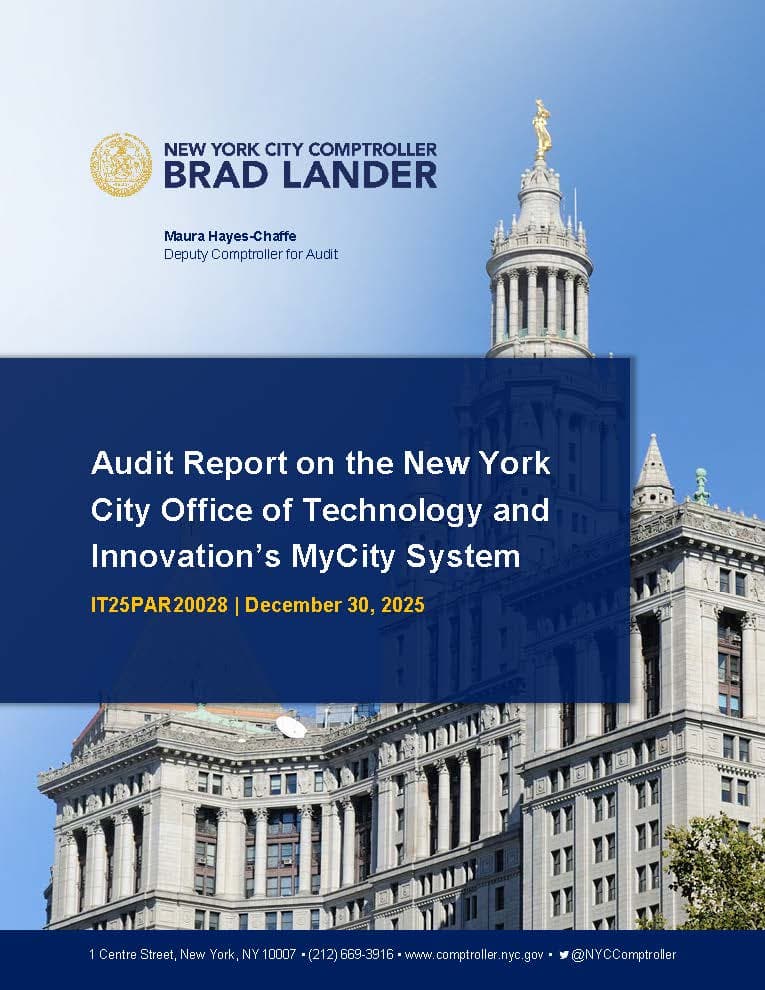
The New York City Comptroller’s Office released a public audit titled “Audit Report on the New York City Office of Technology and Innovation’s MyCity System (IT25PAR20028)”. The report, authored by the Comptroller’s Office staff, examines the MyCity digital portal launched during the Adams administration. It is listed as a Report/Study and was submitted to the database on October 2 2026. The audit is not AI‑generated and is available online at the Comptroller’s website.
Scope and Objectives
The audit evaluates the MyCity system’s performance, cost efficiency, and user outcomes. Its primary goal is to assess whether the portal meets its promise of a one‑stop digital service for city residents, especially concerning applications for childcare and other municipal services. The study focuses on financial expenditures, application eligibility rates, and the effectiveness of automated assistance tools such as the chatbot.
Financial Highlights
The MyCity portal represents an investment exceeding $100 million. The audit scrutinizes how this substantial public spending translates into service delivery outcomes. It notes that the high budget has not yielded proportional improvements in application processing efficiency or user satisfaction.
Childcare Application Findings
A key metric examined is the eligibility of childcare applications processed through MyCity. The audit reveals that 46 % of childcare applications were deemed ineligible, indicating significant challenges in either the eligibility criteria, applicant understanding, or the portal’s guidance mechanisms.
Chatbot Performance
The system includes an AI‑driven chatbot intended to assist users with common queries. The audit tested the bot with 48 questions and found it failed to answer 23 correctly, resulting in a 48 % failure rate. This performance shortfall raises concerns about the reliability of automated support for critical public services.
Compliance and Recommendations
The report concludes that the MyCity system failed to meet several performance benchmarks. It recommends improving data validation processes, enhancing user interface clarity, and redesigning the chatbot to achieve higher accuracy. The audit also suggests a review of the application eligibility framework to reduce the high rate of disqualified submissions.
Relevance to Sustainable Housing in Europe
While the audit concerns a New York City digital platform, its findings are pertinent to European municipalities pursuing sustainable housing initiatives that rely on digital service delivery. The high cost, coupled with low eligibility success and sub‑par chatbot performance, underscores the importance of robust digital infrastructure, transparent criteria, and reliable user support when scaling housing‑related services across regions.
Lessons for Pan‑European Auditors
European auditors can draw several lessons:
- Cost‑Benefit Transparency: Large digital investments must be justified with measurable service improvements.
- Eligibility Clarity: Clear, accessible eligibility rules reduce application rejections and improve housing allocation efficiency.
- Technology Reliability: Automated tools like chatbots should meet stringent accuracy standards before deployment in essential public services.
Conclusion
The Comptroller’s audit provides a data‑driven assessment of the MyCity system, highlighting critical shortcomings in financial efficiency, application eligibility, and chatbot reliability. For European audiences focused on sustainable housing, the report offers a cautionary example of the challenges inherent in digitizing public service delivery and the need for rigorous oversight to ensure that technology investments translate into tangible societal benefits.