Spain
The Country That Built the World's Smart City Stage
Every November, over 25,000 people from more than 140 countries descend on Barcelona for the Smart City Expo World Congress — the world's largest gathering dedicated to urban innovation. It is no accident that this event is hosted in Spain. For more than a decade, Spanish cities have been among Europe's most ambitious and pragmatic laboratories for smart urban management, driven not by a single national vision but by the restless energy of municipalities determined to make their infrastructure work better, their public spaces more livable, and their services more responsive.
Spain's smart city story is fundamentally a tale of two cities — Barcelona and Madrid — whose contrasting approaches have between them produced one of Europe's richest ecosystems for urban technology. Barcelona has pursued technological sovereignty, open-source platforms, and citizen-centred digital rights. Madrid has built an integrated city operations platform that quietly manages services for three million residents. Around them, a national network of over 130 municipalities — the Red Española de Ciudades Inteligentes (RECI) — shares knowledge and standards, while the national government channels EU structural funds into digital transformation across cities and rural territories alike.
Yet Spain also embodies the tensions that smart city work cannot escape. Barcelona's housing crisis — with rents that have doubled in a decade — raises sharp questions about whether innovation districts and tech ecosystems serve all residents equally. Tourism pressure, gentrification, and the uneven geography of economic opportunity between coastal cities and depopulating inland regions form the political backdrop against which every sensor deployment and data platform must justify itself.
Municipal Pragmatism Meets National Ambition
Spain's national smart city framework has evolved through successive funding programmes managed by Red.es, the public agency for digital transformation. The original Plan Nacional de Ciudades Inteligentes (PNCI, 2015) and its successor, the Plan Nacional de Territorios Inteligentes (PNTI), funded 59 projects across the country. In December 2025, the government launched RedCyTI, allocating €89 million in FEDER funds for a sixth round of smart city investment, this time focused on "Smart Economy" — using technology, data, and innovation as engines of local economic development. The programme is notable for requiring that funded projects demonstrate financial sustainability for at least five years after completion, a signal that Spain is moving beyond pilots toward durable infrastructure.
At city level, Barcelona's approach is the most politically distinctive in Europe. The Barcelona Digital City Plan 2023-2027 is structured around five pillars — technological sovereignty, digital inclusion, data-driven management, innovation for the public good, and digital public services. "We don't just ask how we can digitise services," the plan states. "We ask how we can ensure that digital technologies serve all residents equitably." Barcelona is a founding member of the Cities Coalition for Digital Rights, and its open-source-first procurement policy has become a reference for municipalities across Europe seeking alternatives to vendor lock-in.
Madrid's political framing is different but no less ambitious. The city's Madrid Capital Digital strategy emphasises operational efficiency and AI-enabled public services. In November 2025, Madrid City Council awarded Atos a contract to evolve the Madrid Artificial Intelligence Initiative (MAIA), which will develop an ecosystem of generative AI agents to help citizens navigate municipal services. A separate €2.9 million programme will deploy AI for the management of parks and green spaces from 2026. Critics in both cities focus on equity: whether smart city investment strengthens public capacity and inclusion, or primarily optimises operations without addressing distributional questions around housing, tourism, and employment.
Barcelona's Orbit and Madrid's Engine Room
Spain's smart city ecosystem is dense, commercially active, and increasingly international.
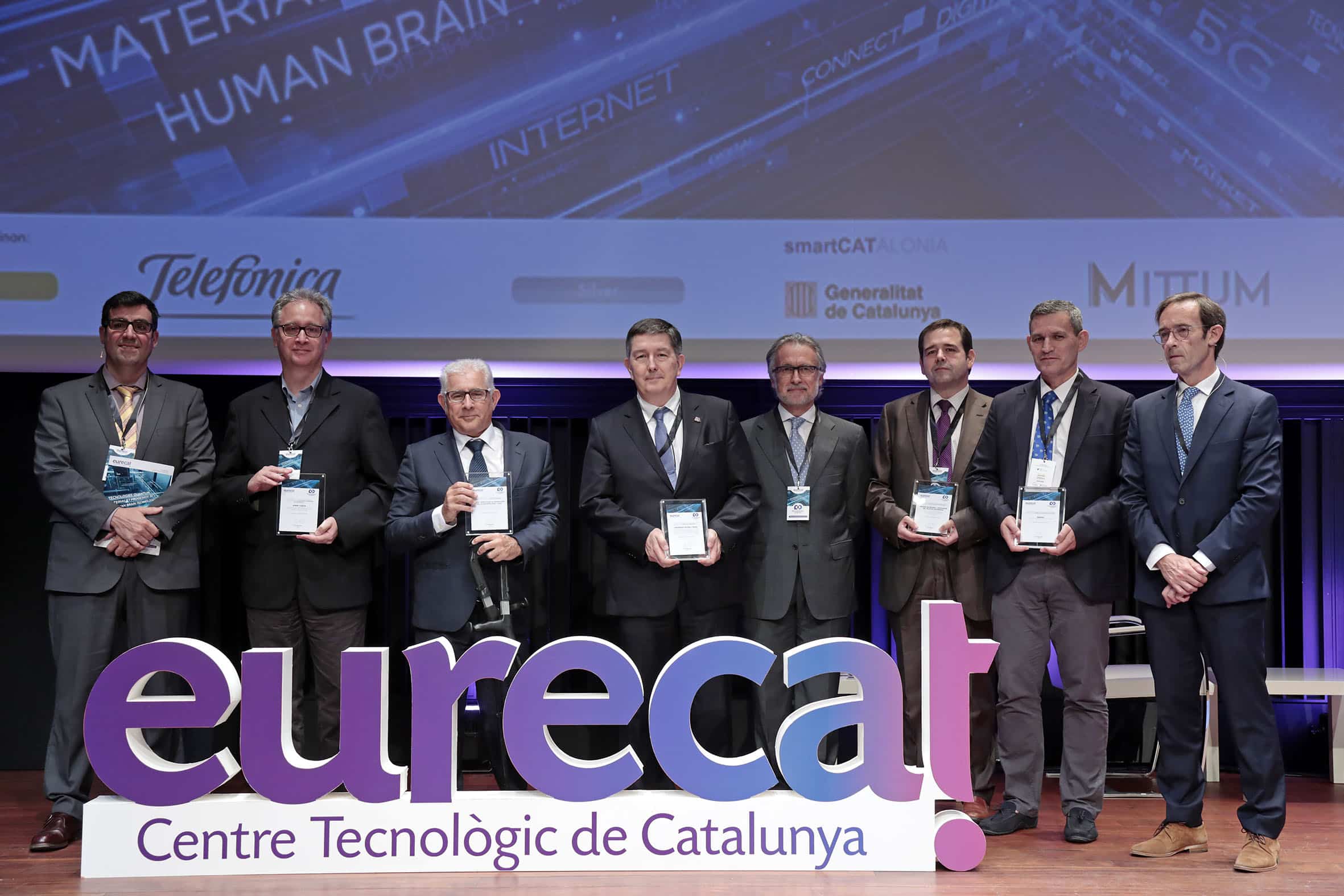
Barcelona anchors the western Mediterranean's innovation economy. The 22@ Barcelona: From Industrial District to Innovation Hub — a 200-hectare former industrial zone in Poblenou, transformed since 2000 — now hosts over 10,000 companies and 150,000 workers in a landscape of repurposed factories and purpose-built tech offices, all connected by district-wide fibre optics, a pneumatic waste collection network, and a seawater district cooling system. The Institut Municipal d'Informàtica (IMI), the city's €113 million technology arm — soon to be rebranded as Barcelona Innovació i Tecnologia (BIT) — manages everything from the sensor network to the city's digital twin. Research institutions deepen the ecosystem: the i2CAT Foundation operates one of Europe's most advanced 5G Living Labs, while Eurecat Technology Centre, Catalonia's largest private technology centre with over 700 researchers, bridges AI, IoT, and sustainability research into deployable urban solutions. The Generalitat de Catalunya — SmartCatalonia initiative coordinates smart city strategies across the region, from Barcelona to rural communities.
Cellnex Telecom, headquartered in Barcelona, is Europe's largest independent telecommunications infrastructure operator, managing over 130,000 sites across 12 countries. Its neutral-host model — building shared 5G and edge computing infrastructure for multiple operators — is reshaping how cities think about digital connectivity, and Barcelona's 22@ district serves as a showcase deployment.
At the social end of the spectrum, the BIT Habitat Foundation applies smart building technologies to affordable housing — using IoT monitoring, intelligent energy controls, and data-driven allocation tools to ensure that innovation serves residents in social housing, not only commercial developments. Pilot buildings have achieved energy consumption reductions of 20–40 per cent.
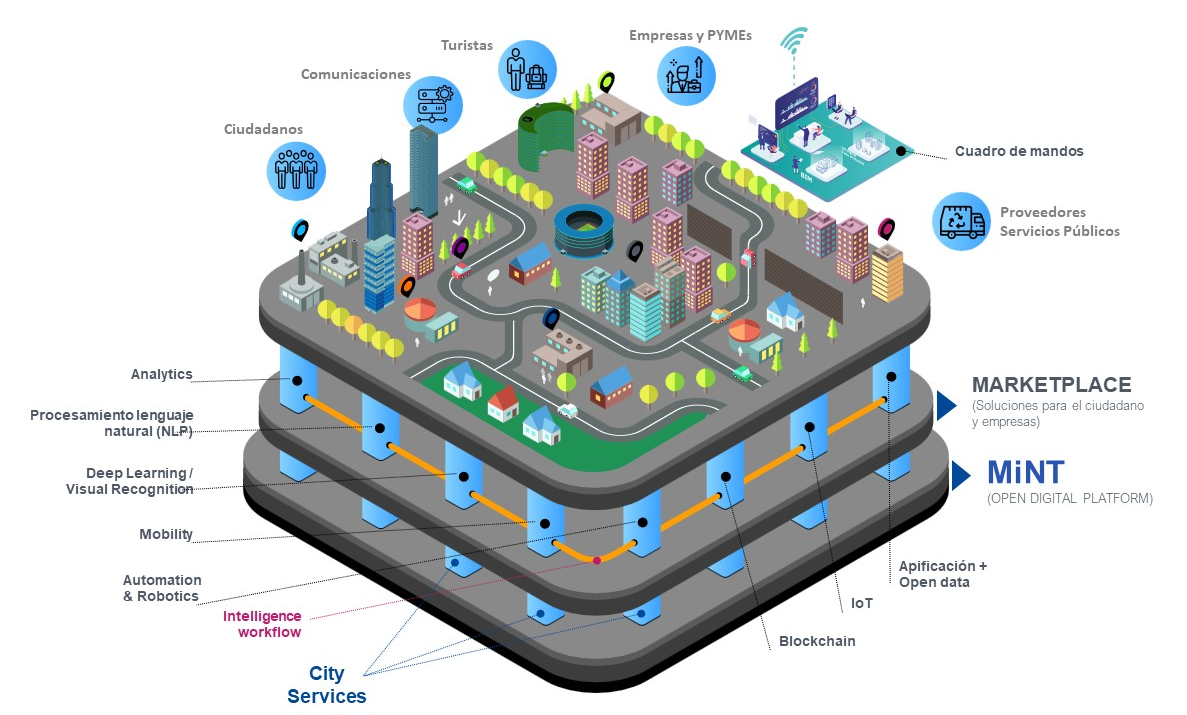
Madrid's ecosystem revolves around the MiNT Madrid Inteligente Platform (Madrid Inteligente), launched in 2014 as a unified city operations system integrating data from thousands of sensors, traffic systems, and environmental monitors across the capital. Over 25,000 public employees use MiNT daily. The platform's machine learning capabilities support predictive decision-making on everything from traffic congestion to waste collection routing, and citizen-facing services through the Madrid city app provide real-time information on transport and air quality. Madrid was recognised at the Smart City Expo World Congress 2024 for its Madrid Data-Based, City Intelligence project, which integrates MiNT with the IoTMadLab, 5G corridors, and the Govtech innovation programme.
From Superblocks to Sensor Meshes
Spain's smart city deployments are distinctive for their scale and their integration with urban design, not merely with technology.
Barcelona's Superblocks (Superilles) programme is perhaps the most influential urban design innovation to emerge from any European smart city. The programme reorganises city streets to prioritise pedestrians, cyclists, and community life over through traffic. Beginning in the Eixample district, the city plans to transform one in three streets by 2030, with a long-term vision of 503 superblocks across the entire city. The results are measurable: reduced air pollution, lower urban heat island effects, and new public spaces for play, socialising, and commerce. The model has been studied by the EU Urban Mobility Observatory and adopted by cities across Europe.
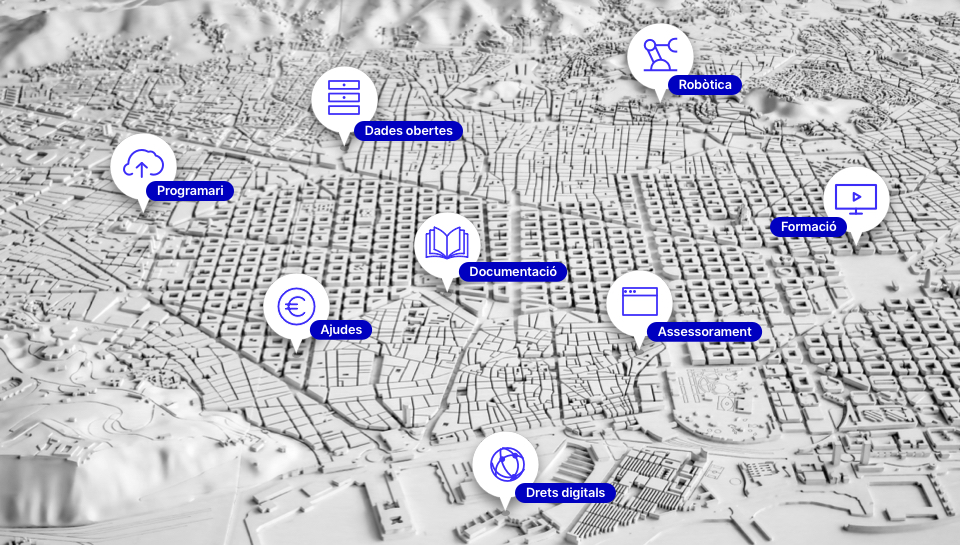
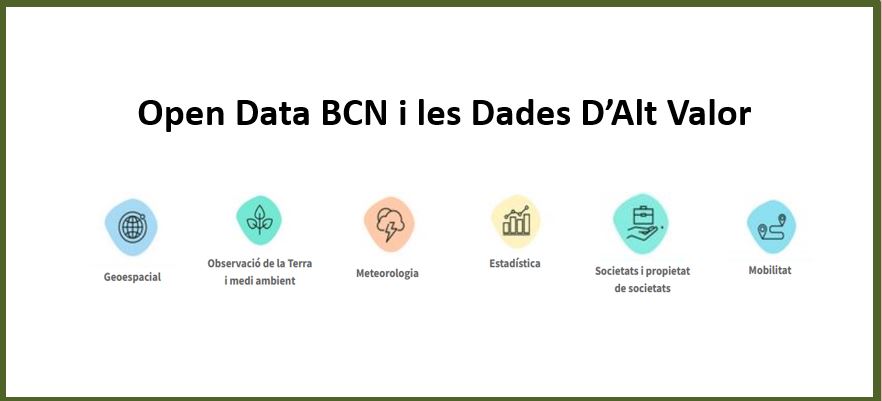
The Sentilo open-source IoT platform — named from the Esperanto word for "sensor" — forms the data backbone of Barcelona's environmental intelligence. Developed by IMI and deployed since 2013, Sentilo collects real-time data from thousands of sensors monitoring air quality, noise, traffic, waste levels, and weather across the city. Its open-source licence means other municipalities can deploy it without vendor lock-in, and several Spanish cities have done so. Sentilo feeds into Open Data BCN — Barcelona Open Data Portal, one of Europe's most comprehensive municipal open data portals, which in turn feeds into the city's participatory democracy platform Decidim.
T-mobilitat — Smart Public Transport Ticketing, Barcelona's next-generation contactless transit card, has replaced paper-based ticketing across the metropolitan area's metro, bus, tram, and commuter rail networks serving 5.5 million people. The system's automatic fare capping ensures passengers always pay the lowest available fare, while real-time passenger data enables transport planners to optimise service frequency for the first time. Bicing 2.0 — Smart Bike-Sharing System, the city's AI-powered bike-sharing system, operates over 7,000 bicycles including e-bikes across 500 stations, with machine learning models predicting demand and dynamically rebalancing the fleet.
Beyond the two major cities, the RECI network demonstrates that smart city thinking is not exclusively metropolitan. Smaller cities like Santander — one of Europe's earliest smart city testbeds — and Zaragoza have developed their own sensor networks and digital services, while the national Plan de Territorios Inteligentes explicitly targets rural areas facing depopulation.
Where the Smart City Meets the Paseo
To experience Spain's smart city in action, begin in Barcelona's Sant Antoni superblock — a former traffic-choked intersection now planted with trees, shaded by canvas canopies, and filled with neighbours sitting, children playing, and market traders selling produce from the adjacent Mercat de Sant Antoni. Sensors embedded in the pavement monitor air quality; the improvement since cars were removed is measurable and visible in the absence of haze.
Walk through the 22@ district and the smart infrastructure is woven into the fabric: pneumatic waste collection points that suck rubbish underground, IoT-connected streetlights that dim when no one is near, and the 5G small cells mounted discreetly on lamp posts that keep the district's thousands of workers connected. Tap a T-mobilitat card at the metro and the system automatically calculates the cheapest fare. Pick up a Bicing e-bike and ride up to Park Güell — the rebalancing algorithms have already ensured there is one waiting.
In Madrid, open the city app and MiNT's data streams are at your fingertips: real-time air quality readings, the nearest available public bike, the status of a pothole report you filed last week. Walk through Retiro Park, and from 2026, AI systems will be managing soil moisture, planting schedules, and irrigation — invisible infrastructure maintaining one of Europe's great urban green spaces.
The Spanish have a cultural habit that the smart city has not replaced but rather reinforced: the paseo, the evening stroll through the neighbourhood, past shops and cafés and plazas where conversations overlap and children run. Barcelona's superblocks have, in effect, re-engineered entire districts to protect and expand the paseo. As Francesca Bria, Barcelona's former Chief Technology Officer, once argued: "Technology must serve the city, not the other way around." In Spain, the smartest urban innovation may be the one that gives people more street to walk on.
References13 resources9 external