Slovenia
Small Country, Big Digital Ambition
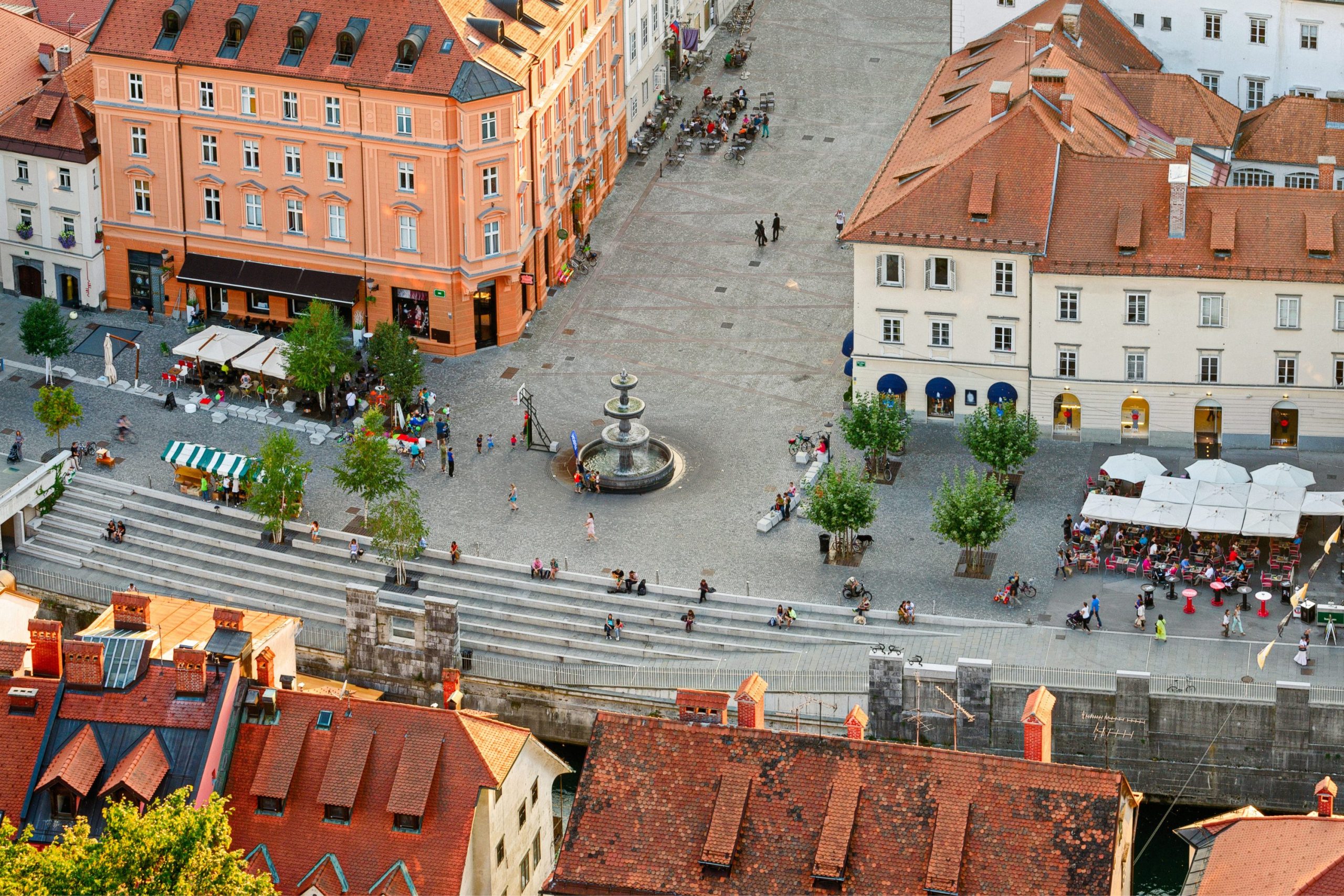
Slovenia is a country of two million people tucked between the Alps, the Adriatic and the Pannonian plain — small enough that almost any reform travels across the whole nation within a few years, ambitious enough to keep ending up in the European top tier of digital league tables. Its capital, Ljubljana, was named European Green Capital in 2016, won the digitalisation award at the European Capital of Smart Tourism 2020 competition and was a finalist in the same contest in 2022 — a string of recognitions for a city of just under 300,000 people.
The national story has shifted in tone since 2023. Where earlier Slovenian smart-city efforts read as a series of green pilots — bike-share, electric buses, sensor-equipped lights — the conversation has moved towards systemic transformation under the umbrella of the Digital Slovenia 2030 strategy, adopted in March 2023. Smart Society 5.0, gigabit infrastructure for all, and a deliberate effort to put data and AI at the heart of public services have replaced isolated demonstration projects as the organising frame.
"Networks of district heating systems represent one of the most important infrastructures that enable decarbonisation through the integration of smart tools, as they allow the efficient integration of a wide range of renewable energy sources," explains Milan Dinevski, member of Ljubljana's transition team and project manager of the UP-SCALE pilot under the NetZeroCities programme.
Digital Slovenia 2030 and the Quiet Modernisation
Slovenia's national framework is unusually integrated for a country of its size. The Digital Slovenia 2030 strategy sets six priority areas: gigabit infrastructure, digital competences and inclusion, digital transformation of the economy, the road to Smart Society 5.0, digital public services and cybersecurity. A March 2023 addendum to the Gigabit Infrastructure Development Plan added measurable indicators for 5G coverage and fibre-to-the-premises rollout.
The strategy is implemented through the Ministry of Digital Transformation — created in 2023 as one of the first dedicated digital ministries in the EU — alongside the longer-standing Ministry of Public Administration, which runs the eUprava one-stop e-government platform. Slovenia is consistently in the top half of the European Commission's Digital Decade scoreboard for digital public services, and almost the entire population can complete major life-event processes — birth, marriage, business registration — online without ever entering a government building.
National funding for urban innovation flows through several channels: the Slovenian Sustainable Smart Specialisation Strategy, the Recovery and Resilience Plan with €2.7 billion in EU support, and the EU Cohesion Funds 2021–2027. Three Slovenian cities — Ljubljana, Kranj and Velenje — are part of the NetZeroCities Pilot Cities Programme, giving the country an outsized presence in the EU's Mission for 100 Climate-Neutral and Smart Cities.
A Network Built on Trust
Slovenia's smart-city ecosystem is small but tightly woven. The Digital Innovation Hub HealthDay.si, founded in Ljubljana, links healthcare providers, technology firms and the University of Ljubljana around connected-health solutions — a model later replicated in other Slovenian sectors. SmartIS City, a Ljubljana-based company specialised in digital municipal solutions, is a key technology partner for environmental sensing and parking management, most visibly in its collaboration with Libelium at BTC City Ljubljana, one of Europe's largest shopping and business centres.
Academia is a heavyweight in a country this size. The University of Ljubljana's Faculty of Computer and Information Science and the Jožef Stefan Institute — the country's largest research institution — supply the AI, IoT and data-science expertise that local pilots and start-ups draw on. The Ljubljana Forum, held annually since 2011, has become the country's flagship gathering for urban innovation, drawing mayors and researchers from across the region and awarding a prize for green and digital urban leadership.
Industry voice is supplied by the Chamber of Commerce and Industry of Slovenia and the SRIP smart-cities innovation partnership. Bridges to EU innovation flow through the Living-in.EU Smart Communities support programme, where Slovenia is one of the most active beneficiaries.
Ljubljana, the BTC Quarter and the Carbon-Neutral Pilots
Three projects illustrate the range of Slovenian smart-city practice.
The Digital Development Strategy of the Municipality of Ljubljana sets five strategic goals across digital infrastructure, services, data, skills and ecosystem. Each measure has a public "traffic-light" status indicator on the strategy's open dashboard — an unusually transparent accountability device. Beneath it sit concrete projects: the Tap Water Ljubljana app guiding residents to over 30 public drinking-water fountains, the WiFree Ljubljana network with more than 400 access points, the integrated Urbana city card combining transport, parking, library and bike-share, and an open-data portal that grows year on year.
BTC City Ljubljana, in cooperation with SmartIS City and Libelium, has turned a 475,000-square-metre commercial district into a living testbed. Deployed sensors monitor noise, air quality, footfall and energy use, feeding a public dashboard used by tenants and visitors. The accompanying "Green Mission" programme converts technical data into building-level efficiency interventions, framed by BTC's own sustainability strategy.
The SHIFT (Shaping Habits for Innovative Future Transformations) project, launched in December 2025 under the NetZeroCities umbrella, links digital innovation with citizen engagement and green-infrastructure pilots across Ljubljana. In parallel, Kranj and Velenje are testing digital twins of district-heating networks, hydrogen pilots in industrial mobility, and AI-supported building-renovation decision tools — small in scale, but explicitly designed to be replicable in mid-sized cities across the EU.
"Smart Society 5.0 is not a slogan: it is what we expect when data, AI and trust come together to serve people, climate and the country at the same time," reads the introduction to the Digital Slovenia 2030 strategy, capturing the country's signature mix of technological ambition and social pragmatism.
Experience the Smart City: Bees, Lake Walks and the Sound of a Country at Ease
Slovenia is the only EU member state where beekeeping (čebelarstvo) is recognised as part of UNESCO's intangible cultural heritage, and a country where the Carniolan honey bee (Apis mellifera carnica) is a national symbol with its own holiday — World Bee Day on 20 May, an initiative proposed by Slovenia and adopted by the United Nations in 2017. Walk through a Ljubljana suburb on a summer evening and you will pass apiaries on apartment-block roofs alongside QR-coded "bee paths" connecting urban hives — a charmingly low-tech smart-city node where biodiversity, education and digital wayfinding meet.
Then, on a Sunday, the country walks. From the karst caves to Lake Bled, from Triglav National Park to the wooded shores of Lake Bohinj, the sprehod — a leisurely outdoor stroll, ideally ending with a slice of poppy-seed potica and a glass of Cviček — is the rhythm into which any digital intervention has to fit. Slovenian urban innovators talk a lot about technology, but they walk a lot in nature, and they tend to design systems that respect that balance. If a smart city should make space for the people who live in it, then Slovenia, on a quiet weekend morning, looks like an early proof of concept.