Loading...
City
Dublin
Country🇮🇪 Ireland
The Testbed on the Liffey
Dublin does not look like a typical smart city showcase. There is no gleaming control room, no single flagship tower bristling with sensors. What the Irish capital has built instead is a distributed network of urban laboratories — five Smart Districts spread across the metropolitan region — where technology is tested not for spectacle but for practical municipal use. It is an approach that reflects something deeper about Ireland's relationship with innovation: pragmatic, collaborative, and instinctively wary of overpromising.
With a population of just under 600,000 in the city proper and over 1.4 million in the greater Dublin area, Ireland's capital sits at an unusual crossroads. It hosts the European headquarters of Google, Meta, Microsoft, and dozens of other global technology companies, giving it one of Europe's densest concentrations of tech talent. Yet many of the city's own public services still grapple with legacy infrastructure, housing pressure, and the everyday friction of a fast-growing capital. Smart Dublin, the collaborative initiative founded by the four Dublin Local Authorities, was created to bridge that gap — connecting the innovation capacity sitting in the Docklands with the operational needs of a city under pressure.
In 2025, Dublin City Council published its Digital Transformation Strategy 2025–2030, setting out how the council plans to make Dublin a "dynamic and sustainable digital city" by the end of the decade. The strategy commits to six principles — public service excellence, sustainability, leadership, ambition, fairness, and accountability — and frames digital innovation as a tool for better governance rather than an end in itself.
A year later, the council is in the middle of re-engineering how it actually delivers on that strategy. In February 2026, Jamie Cudden — who led the Smart Dublin programme for over a decade — outlined to Cities Today how he is now bringing innovation, enterprise IT, data and cyber security into closer alignment in his expanded role as Executive Manager for Corporate Services and Transformation, in an explicit shift from "pilots and sandboxes to scalable, business-led change."
Four Councils, One Digital Strategy
Dublin's smart city governance is distinctive because it operates across four independent local authorities: Dublin City Council, South Dublin County Council, Fingal County Council, and Dún Laoghaire–Rathdown County Council. Rather than each authority pursuing its own digital agenda, Smart Dublin acts as the coordinating layer — a shared programme that pools resources, aligns priorities, and ensures that innovations tested in one district can scale across the region.
Within Dublin City Council, a dedicated Dublin City Council — Smart City Unit manages the day-to-day coordination of technology pilots, procurement frameworks, and partnerships with academia and industry. The unit has developed an unusually transparent approach to project management, publishing its full project portfolio on a publicly accessible board where anyone can track what is being tested, where, and by whom.
Dublin was also selected as one of four cities worldwide to pilot the Cities Coalition for Digital Rights and UN-Habitat's Digital Rights Governance Framework. In 2019, Smart Dublin launched an "Ethics and the Smart City" research partnership with Maynooth University, embedding ethical review directly into the programme's operations. The partnership involves "case-study analysis of Smart Dublin projects through an ethical lens, development of ethics check tools, and embedding ethics in day-to-day programme management practices," according to the Coalition's documentation. In a city hosting some of the world's largest data companies, the municipal government has clearly decided it must hold its own technology use to the highest standards of transparency.
The All Ireland Smart Cities Forum extends this collaborative ethos beyond Dublin's borders, connecting municipalities and technology organisations across both the Republic of Ireland and Northern Ireland in a cross-border knowledge-sharing network — a rare example of smart city cooperation that bridges a political boundary.
Where Silicon Docks Meets the Sensor Network
The ecosystem powering Dublin's smart city work draws on an unusual concentration of publicly funded research capacity. CONNECT — SFI Research Centre for Future Networks, the Science Foundation Ireland (SFI) Research Centre for Future Networks headquartered at Trinity College Dublin, brings together over 450 researchers from ten Irish universities to work on 5G, low-power wide-area networks, edge computing, and artificial intelligence. CONNECT is a founding partner of the Smart Docklands Testbed testbed and provides the technical backbone on which many of Dublin's pilots run.
Science Foundation Ireland (SFI) itself invests over €200 million annually in research, with several SFI-funded centres directly feeding the smart city pipeline: CONNECT for future networks, Insight for data analytics, LERO for software engineering, and ADAPT for digital media and AI. This publicly funded research infrastructure gives Dublin's smart city programme access to capabilities that many cities must procure commercially.
On the entrepreneurial side, Dogpatch Labs Dublin, located in the CHQ Building at the heart of the Docklands, operates as Ireland's leading startup hub. Housing over 100 companies at any time and running the NDRC (National Digital Research Centre) accelerator, Dogpatch connects early-stage ventures — many working on urban mobility, sustainability, and civic technology — directly with municipal partners and the Smart Docklands testbed next door.
Events like the Dublin Tech Summit 2026, Smart Dublin Innovation Week 2025, and the Smart Cities Ireland Annual Forum 2026 keep the ecosystem connected and visible, drawing practitioners from across Ireland and Europe. In May 2026, the second edition of Dublin Tech Week (22–29 May) is set to convene the entire community around the theme "Innovating Together for a Smarter City."
From Docklands Drones to Community Health AI
Dublin's Smart District model concentrates innovation in five designated zones, each with a different thematic focus. Smart Docklands Testbed, launched in 2018, is the flagship: a testbed in an area where over 40,000 people work and 26,000 live, running pilots in environmental monitoring, IoT sensor deployment, NB-IoT connectivity with Vodafone, and 5G trials. The programme operates as an "honest broker" between city government, industry, universities, and residents — a deliberate design to prevent technology from being deployed for its own sake.
The Twin for Resilience (T4R) Digital Twin Project Interreg project represents Dublin's most ambitious investment in digital twin technology. Different departments of Dublin City Council have been experimenting with drones, building information models (BIM), and LIDAR scanning to create high-resolution 3D models of the city. One striking application: a digital twin built with Dublin Fire Brigade that integrates sensor data, hydrant locations, utility lines, and census information to reduce pre-incident planning time for firefighters, enabling real-time routing decisions during emergencies.
Perhaps the most distinctive district is Smart D8 Health and Wellbeing District, Dublin's first smart district dedicated entirely to community health and wellbeing. Located in the diverse Dublin 8 neighbourhood with 45,000 residents, Smart D8 began by surveying 346 community members to identify health priorities — then built its entire programme around those answers. After three years, the initiative had "facilitated the implementation of 12 scalable pilot projects, engaging over 5,000 end users" and "attracted over €500,000 in research funding and investment," according to its European Public Sector Award submission. Recent pilots include using AI to accelerate cancer detection, remote heart monitoring for patients with heart failure via connected devices, and community football programmes supporting men's health. In 2025, Smart D8's collaboration with MoveAhead won Ireland's national Citizen Engagement Award.
The Dublinked Open Data Platform open data platform provides the connective tissue beneath all of this: over 890 datasets from all four Dublin authorities, covering transport, environment, planning, housing, and local services — a regional data commons that has attracted over 30,000 users annually and inspired replication in other European cities.
The City That Reads Its Own Rivers
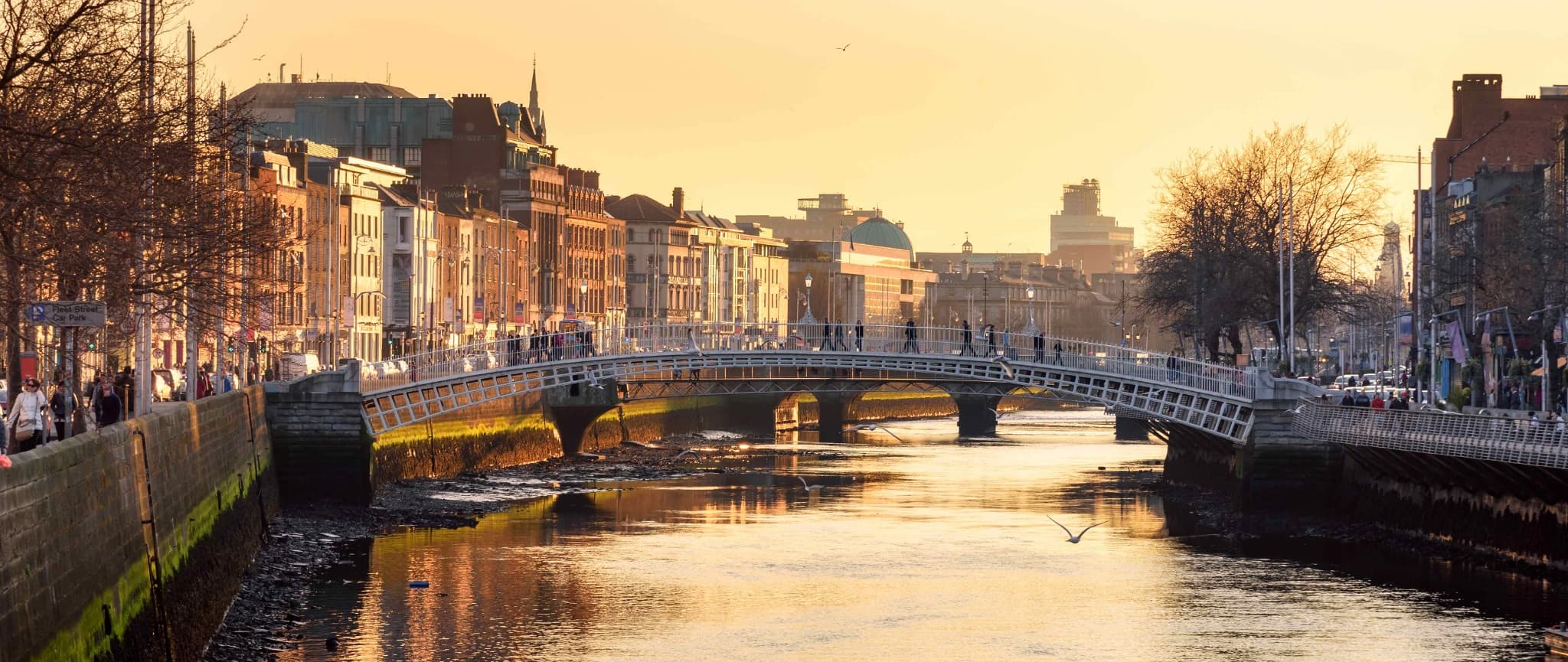
To experience Dublin's smart city in daily life, look at the water. In 2024, Smart Docklands deployed sensors in the River Liffey and the Tolka, capturing live data on river levels, flow rates, and water temperature. Dubliners can now check real-time conditions before kayaking, swimming, or simply walking along the quays — a small innovation that connects civic technology directly to the city's intimate relationship with its waterways.
Or consider the Dublin Active Travel Dashboard, highlighted by the World Health Organisation as a model for evidence-based urban mobility. The dashboard combines cycling and walking counts with infrastructure mapping, public health projections using the WHO HEAT tool, and estimated financial savings from active transport — giving planners and citizens a shared, data-rich picture of how Dublin moves.
At Dublin City University, the Smart DCU campus uses IoT sound sensors and digital crowd counting to support intelligent routing for people on the autism spectrum — allowing navigation via the least stressful paths. It is a reminder that "smart" can mean profoundly human when the technology is designed around the right question.
Dublin's relationship with technology has always been shaped by its literary culture — a city of storytellers instinctively sceptical of grand narratives. The Academy of the Near Future, a smart communities education programme run by CONNECT and Dublin City Council, captures this sensibility. Rather than selling a vision of the future, it builds "awareness, skills, and confidence" so that more people can "engage confidently in shaping the future of our cities and societies." In Dublin, the smart city is less a destination than an ongoing conversation — conducted, as most things here are, with pragmatism, wit, and a healthy dose of doubt.
References13 resources11 external
Resources
Event
Dublin Tech Summit 2026
Tech leaders, startups, and policymakers explore AI, sustainability, and smart city innovations.
Event
Smart Dublin Innovation Week 2025
For local authorities, tech partners, academia, and citizens: showcasing Dublin's smart city innovations.
Organisation
Smart D8 Health and Wellbeing District
Uses AI, IoT and community engagement to prevent illness in Dublin 8 area.
Organisation
Dogpatch Labs Dublin
Startup hub offering workspace, community, and acceleration programs for tech innovators.

Organisation
Science Foundation Ireland (SFI)
Funds scientific research, builds research centres, and translates innovation into applications.

Organisation
CONNECT — SFI Research Centre for Future Networks
Researches advanced networks, IoT, AI for smart cities, industry partnerships, graduate training.
Organisation
All Ireland Smart Cities Forum
Cross‑border network enabling municipalities and partners to collaborate on smart city innovation.
Organisation
Smart Dublin
Collaborative initiative trialing and scaling innovative smart‑city solutions across Dublin.
Knowledge
Dublinked Open Data Platform
Regional open data hub uniting four Dublin authorities, offering 300+ datasets, GIS formats, and smart insights.
Organisation
Smart Docklands Testbed
Facilitates smart city trials, engages community, and bridges research with urban challenges.

Project
Twin for Resilience (T4R) Digital Twin Project
High‑resolution 3D city models, flood‑risk simulations, and cross‑European data‑sharing collaborations.
Organisation
Dublin City Council — Smart City Unit
Coordinates smart city pilots, partnerships, and digital innovations for municipal services improvement.
Event
Smart Cities Ireland Annual Forum 2026
Municipal leaders and smart city practitioners discuss Ireland's smart city development and implementation.
External Sources
Digital Transformation Strategy 2025–2030dublincity.ieDublin — Cities Coalition for Digital Rightscitiesfordigitalrights.orgSmart D8: A Population Health and Well-being Demonstratoreipa.euDigital Twins Implementation in the City of Dublinaecbytes.comUsing Data to Expand Safe Active Travelwho.intAcademy of the Near Futurenearfuture.ieDubliners Empowered with Real-Time River Datasmartdublin.ieSmart Dublin — Aboutsmartdublin.ieInside Dublin's next phase of digital transformationcity-innovation.netDublin Tech Week 2026: Innovating Together for a Smarter Citysmartdublin.ieNTA sets out transport priorities for Dublin in 2026–2030 strategydublinpublictransport.ie