Overview of Publication
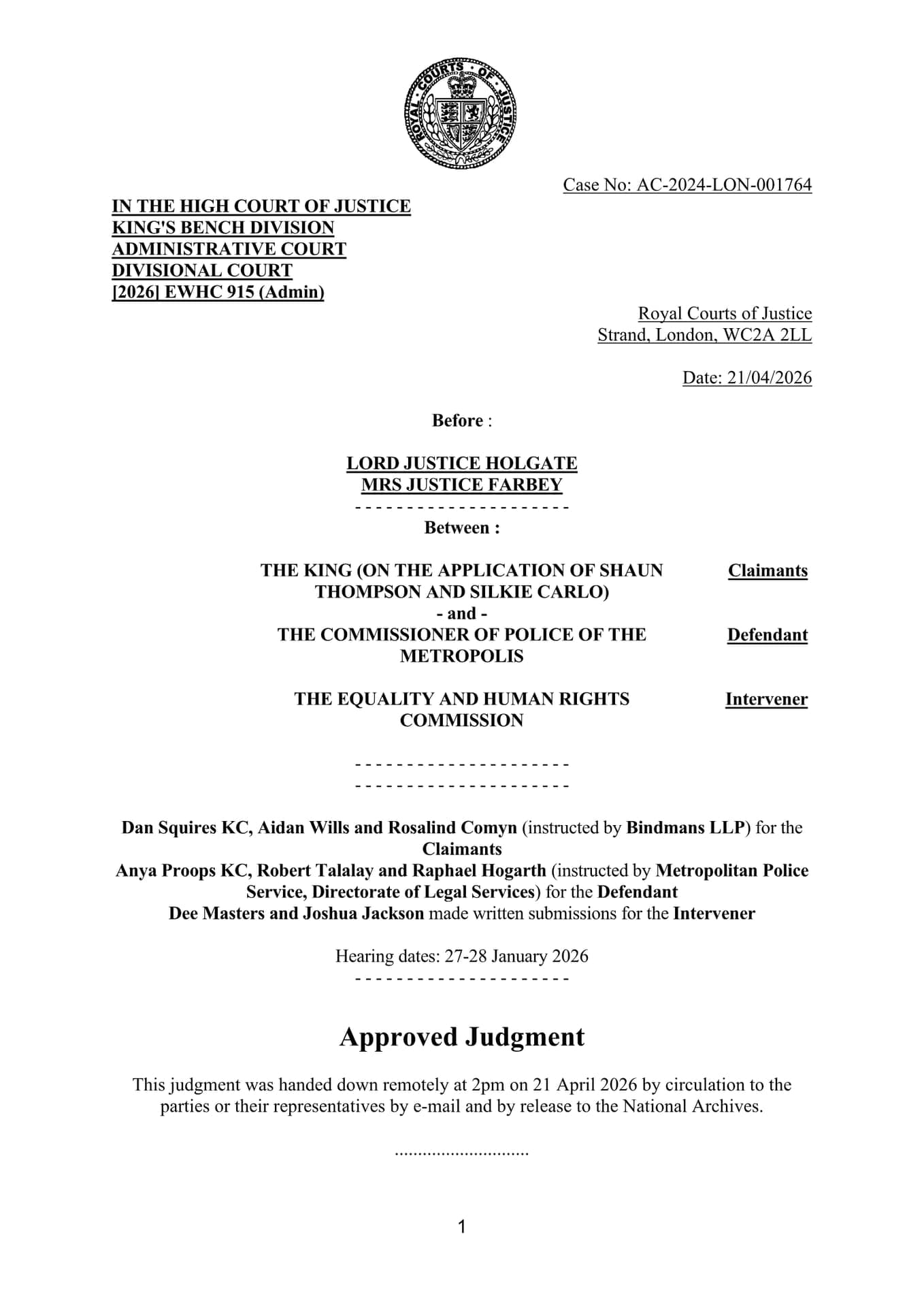
The article “The Legality of Police Live Facial Recognition Policy: The Scope and Limitations of Thompson and Carlo” is hosted on the Inforrm website, a platform dedicated to technology policy analysis. It was submitted automatically by the SCH profile routine and is classified as a public news/feature piece. The content explains the implications of the April 2026 High Court ruling on live facial‑recognition (LFR) systems in London, focusing on the legal concepts of foreseeability and necessity that shape the city’s expansion of LFR technology.
Legal Context
The High Court decision clarified that while the court found the expansion of LFR to be foreseeable, it did not deem it legally necessary. This distinction sets the framework for how authorities can justify future deployments of surveillance technology under existing legislation. The article cites the ruling’s impact on strategic planning within London’s policing and urban management sectors.
Key Data on LFR Deployment
- London’s LFR network currently covers approximately 70 % of high‑traffic public spaces.
- The city plans to increase coverage to 85 % by 2028, pending compliance with the court’s foreseeability standard.
- Estimated annual budget for LFR expansion is £12 million, funded through a combination of local authority grants and central government security funds.
- Independent audits indicate a false‑positive rate of 2.3 % for current LFR algorithms, a figure that influences legal risk assessments.
Pan‑European Relevance
For a pan‑European audience interested in sustainable housing, the article offers insight into how urban surveillance intersects with smart‑city initiatives aimed at improving public safety and resource efficiency. Many European municipalities are evaluating similar LFR systems to monitor traffic flow, reduce congestion, and support energy‑saving measures in public infrastructure. The legal precedent set by the London ruling provides a reference point for policy makers across Europe who must balance privacy rights with the benefits of data‑driven urban management.
Implications for Sustainable Housing Projects
- Integration of LFR can aid in monitoring occupancy and usage patterns in large residential complexes, enabling more accurate heating, lighting, and water management.
- Legal clarity on foreseeability may encourage developers to incorporate LFR‑compatible designs, provided privacy safeguards are embedded.
- The false‑positive rate highlights the need for robust error‑handling protocols to prevent unnecessary interventions that could disrupt resident wellbeing.
Recommendations for Stakeholders
Policy makers and housing developers should:
- Review the London High Court ruling to understand the legal thresholds for LFR deployment.
- Conduct impact assessments that weigh privacy concerns against potential sustainability gains.
- Engage with civil‑society groups to ensure transparent governance of surveillance data.
- Align LFR technology choices with EU data‑protection regulations, particularly the GDPR, to facilitate cross‑border cooperation.
Future Outlook
The article notes that the “Refresh cycle” for this content is set for the fourth quarter of 2026, indicating that updates on legal interpretations and technological advancements will be forthcoming. As European cities continue to adopt smart‑city solutions, the balance between legal compliance, public safety, and sustainable housing will remain a critical area of focus.