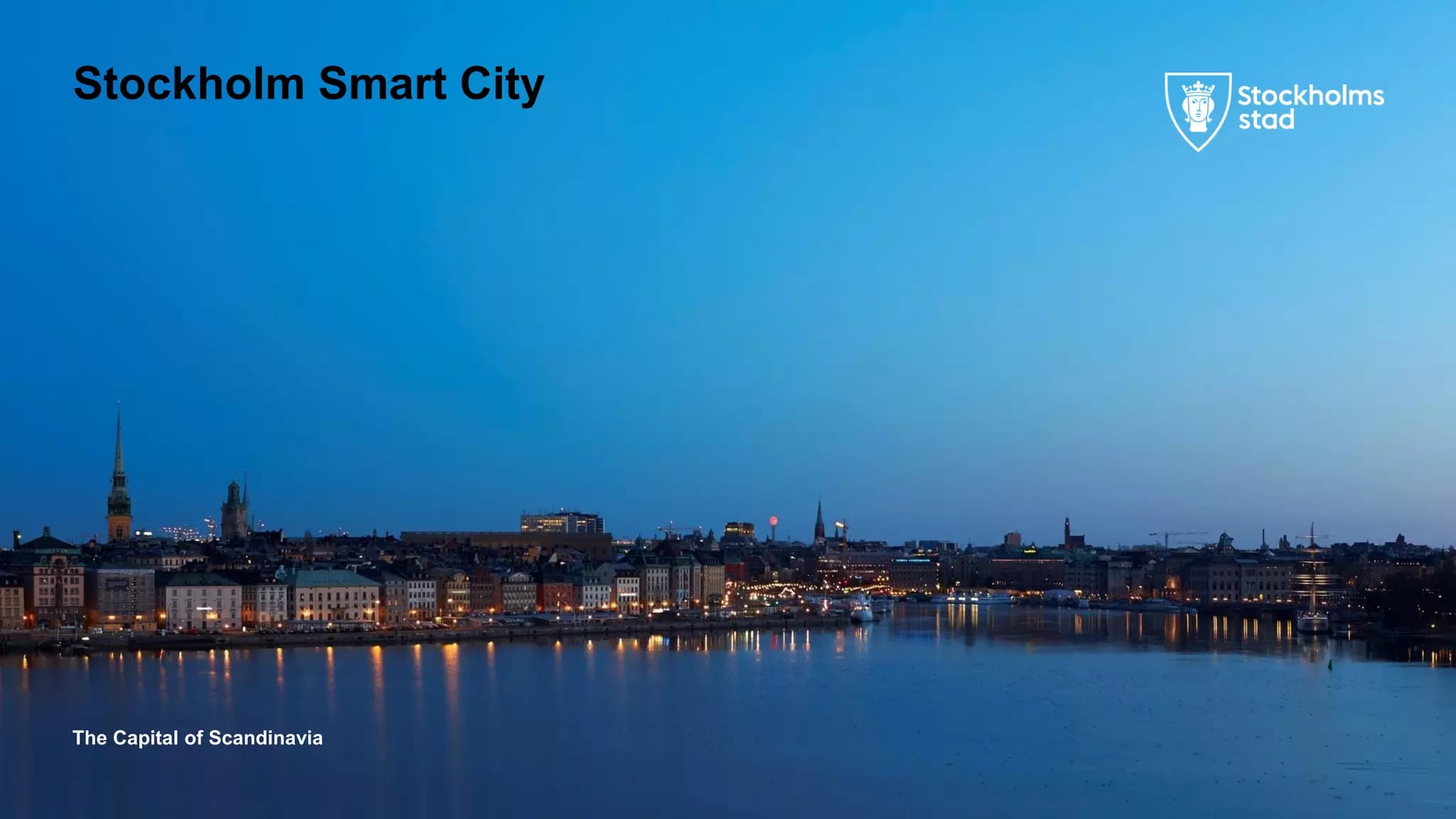
Overview of Stockholm’s Smart City Strategy
The Stockholm Smart and Connected City Strategy is a public initiative aimed at making Stockholm the world’s smartest city by 2040 while achieving carbon neutrality. The strategy, adopted by the Stockholm City Council in 2017, is guided by four sustainability pillars—economic, ecological, democratic, and social—and three core principles: innovation, openness, and connectivity. It positions digitalisation as a key enabler of sustainable urban development, linking technology directly to the city’s climate goals.
Digital Infrastructure as the Foundation
A central pillar of the strategy is Stokab, the city‑owned operator of an open fibre‑optic network established in 1994. Stokab provides competition‑neutral dark‑fibre infrastructure with near‑universal coverage, leasing capacity to telecom operators, businesses, public agencies and other organisations. This extensive fibre backbone supports broadband connectivity, Internet of Things (IoT) deployments, and data‑centre operations, giving Stockholm one of the most advanced urban fibre networks worldwide.
Six Project Areas Driving Innovation
The strategy is organised into six project areas. Three focus on urban interventions: smart locks for city buildings, smart and connected street lighting, and intelligent traffic‑management systems. Two facilitating projects address open and shared data platforms and the technical conditions needed for smart‑city deployment. A sixth “open project” category allows city agencies to apply for funding for innovative digital services that fall outside the predefined areas.
Demonstrator Districts Showcasing Solutions
Two districts serve as testbeds. The Royal Seaport (Norra Djurgårdsstaden) in the northeast functions as a living lab for sustainable technologies, including IoT sensors, energy‑system optimisation, construction‑logistics innovation, and efficient waste and wastewater management. Kista Science City in the northwest, a hub for ICT firms and research institutions, drives 5G development and broader digital innovation.
Collaboration Across Sectors
The strategy was co‑created with residents, academia and business. Implementation involves coordination among municipal agencies and partnerships with private firms such as Ericsson (5G and IoT) and Vattenfall (district heating and renewable energy). Research contributions come from institutions like KTH Royal Institute of Technology, which support pilot projects and evaluation.
Key Technological Priorities and Applications
Core priorities include the Internet of Things, 5G connectivity, expansion of data centres leveraging Stockholm’s cool climate and renewable energy, publicly accessible open data, and innovation platforms. Practical applications span intelligent traffic‑management to cut congestion and emissions, adaptive smart street lighting with integrated sensors, expanded e‑services for residents and businesses, and data‑driven urban‑planning tools.
International Recognition and Impact
Stockholm’s approach earned global acclaim when it was named Smart City of 2019 at the Smart City Expo World Congress in Barcelona. The jury highlighted the strategy’s integration of innovation, openness and connectivity to enhance residents’ quality of life and create a favourable environment for business.
Relevance for Sustainable Housing in Europe
For a pan‑European audience focused on sustainable housing, the strategy demonstrates how digital infrastructure can underpin energy‑efficient buildings, real‑time monitoring of resource use, and citizen‑centric services. Open fibre networks enable smart home technologies, while the city’s commitment to carbon neutrality ensures that digital solutions are paired with renewable energy sources. The demonstrator districts illustrate scalable models for integrating smart‑housing concepts into broader urban development, offering valuable lessons for other European cities aiming to combine sustainability with digital transformation.