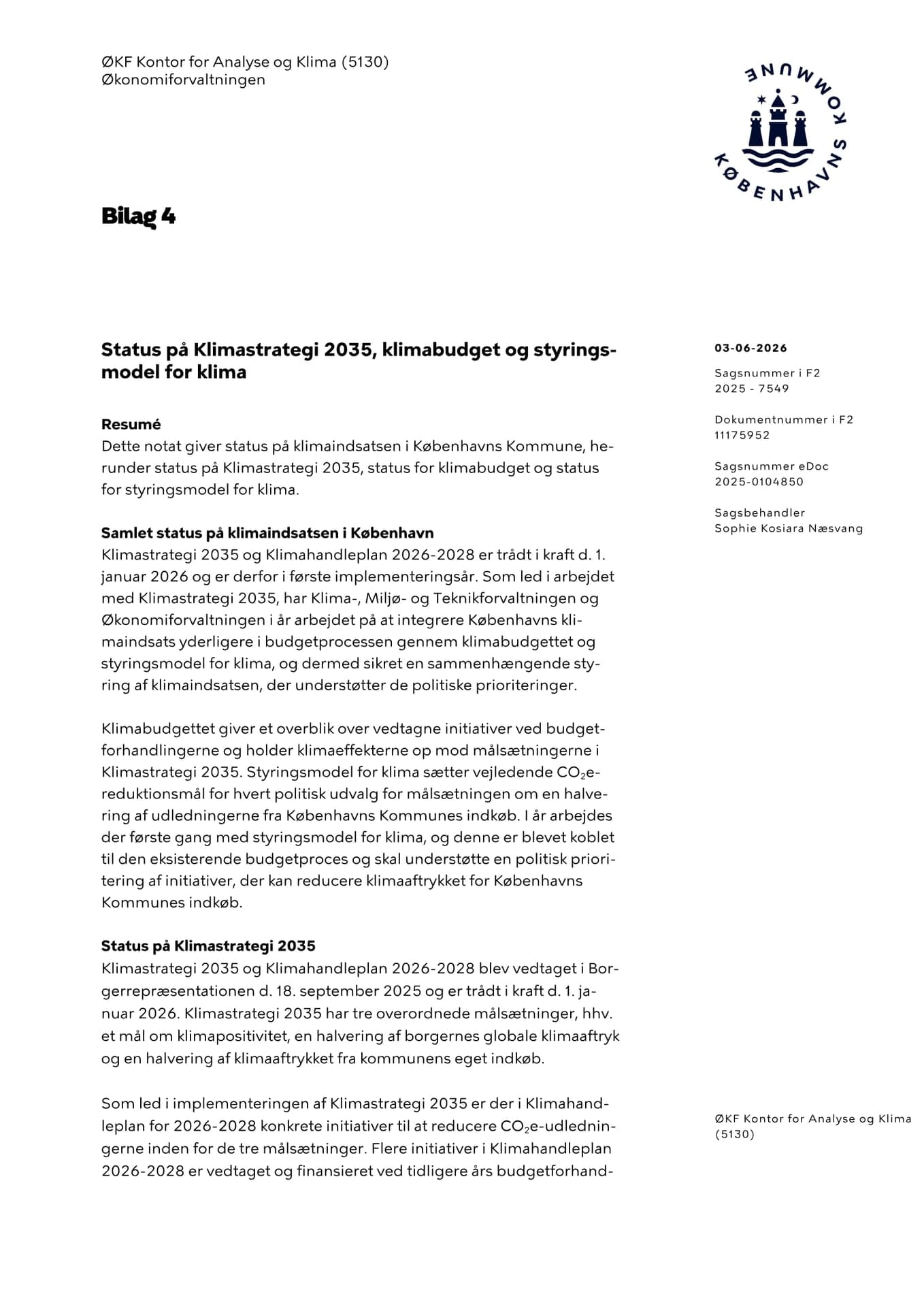
Overview of the Climate Strategy Document
The document titled “Status på Klimastrategi 2035, klimabudget og styringsmodel for klima” is an official policy report produced by the Economic Administration of the City of Copenhagen. It presents the latest assessment of Copenhagen’s climate strategy, budget allocations, and governance model aimed at achieving the city’s climate targets for 2035. The report is publicly available and was submitted to the city’s database on 16 October 2026.
Climate Goal and Current Trajectory
Copenhagen’s 2035 climate ambition is to reduce greenhouse‑gas emissions by 68 % compared to the 2019 baseline. The current trajectory indicates that without additional measures the city will fall short of this target. Progress is especially limited in the housing sector, where only about 30 % of the planned energy‑efficient retrofits are on track.
Climate Budget Allocation
The report details the allocated climate budget, highlighting funded measures that support carbon capture and storage (CCS) as the only positive contributor to meeting the reduction target. Other budget lines show insufficient funding for large‑scale building renovations, renewable energy integration, and low‑carbon transport initiatives.
Sustainable Housing Initiatives
Key data on sustainable housing include:
- Target to retrofit 40 % of the municipal housing stock by 2035.
- Current retrofit rate stands at roughly 12 % of the total stock.
- Funding shortfall of €150 million for the next five years, jeopardising the achievement of energy‑efficiency standards.
- CCS projects receive 22 % of the climate budget, underscoring a reliance on technological solutions over building upgrades.
Emission Reductions by Sector
The sector‑specific breakdown shows:
- Buildings: 45 % of total emissions, with a modest 5 % reduction achieved to date.
- Transport: 30 % of emissions, with a 7 % reduction thanks of increased cycling infrastructure.
- Industry and waste: remaining emissions, with limited progress reported.
Governance Model and Decision‑Making
The governance model outlined in the document assigns responsibility to the Economic Administration, the Climate Council, and municipal departments. Decision‑making follows an auto‑approved routine under the tenant library‑promotion policy, ensuring rapid integration of new data. The model emphasizes cross‑departmental coordination but notes gaps in data sharing between housing authorities and energy providers.
Implementation Challenges
The report identifies several barriers to meeting the 2035 targets:
- Insufficient financing mechanisms for private‑owner retrofits.
- Limited availability of skilled labor for large‑scale renovation projects.
- Dependence on CCS technology, which remains in early deployment stages.
- Regulatory hurdles that slow down permitting for renewable energy installations on residential buildings.
Outlook and Recommendations
To bridge the gap, the document recommends:
- Increase the climate budget for housing retrofits by at least 30 %.
- Introduce incentive schemes for private homeowners to adopt energy‑efficient upgrades.
- Accelerate pilot CCS projects while diversifying mitigation strategies.
- Strengthen data integration across municipal departments to improve monitoring. These actions are presented as essential for Copenhagen to align its housing sector with the broader European push for sustainable, low‑carbon urban environments.