Overview of the Report
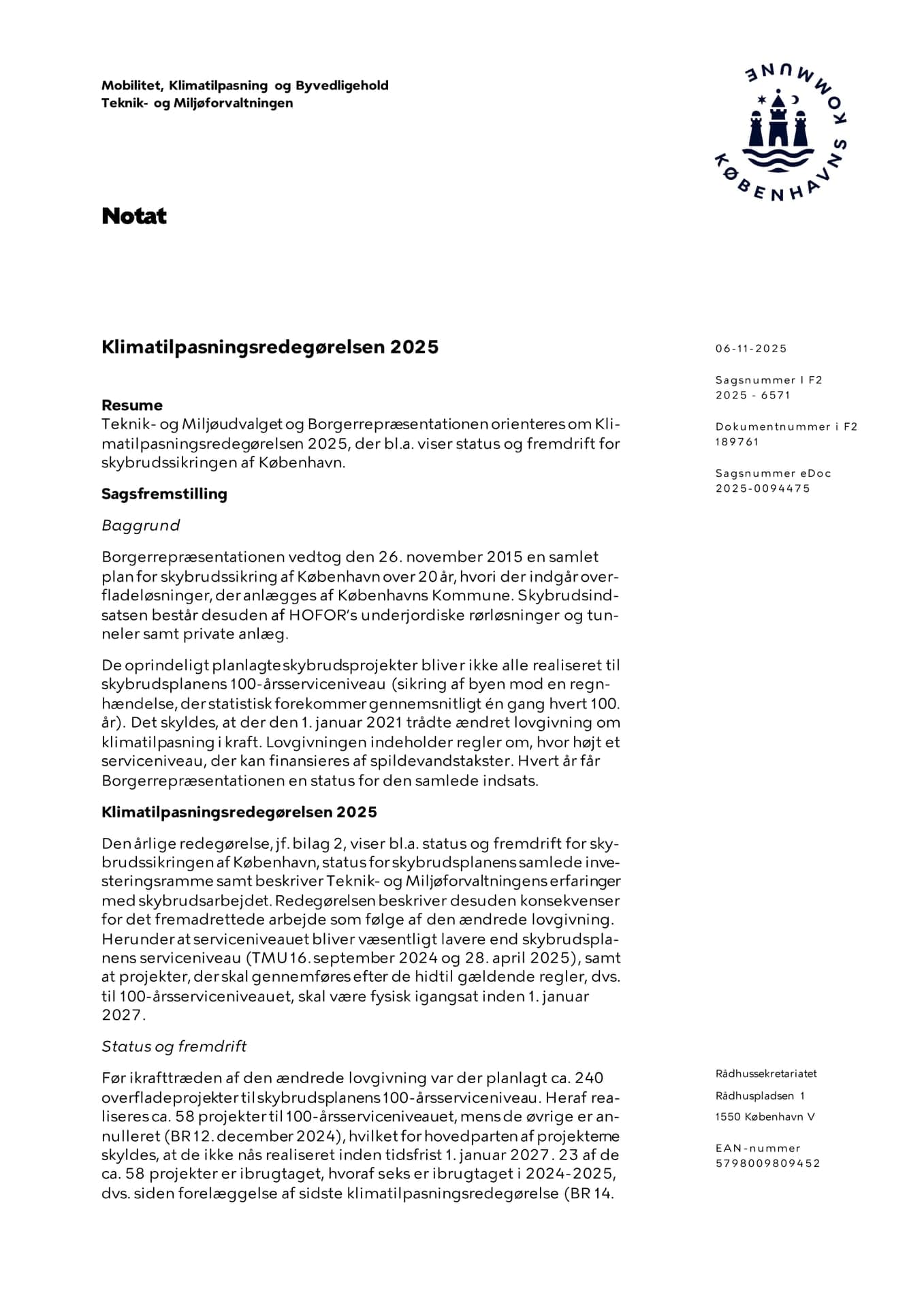
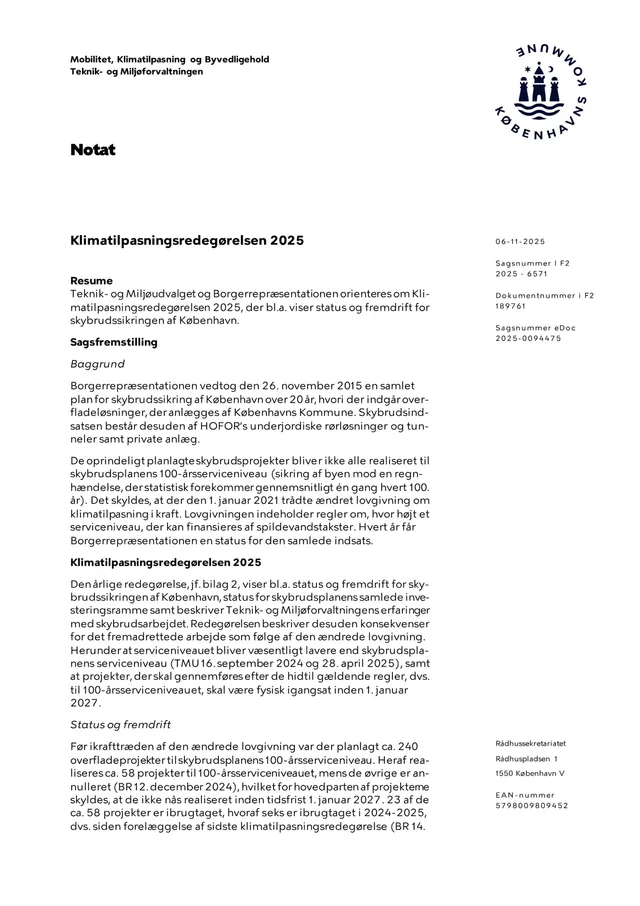
The document titled “Klimatilpasningsredegørelsen 2025” is a public report issued by the Technical and Environmental Administration of Copenhagen. It presents the city’s climate adaptation plan, focusing on measures to protect residents from increasing flood risks and to align infrastructure with the 100‑year standard set by the 2021 national rule change.
Scope of Climate Adaptation
The report evaluates 242 surface water projects across Copenhagen, identifying that only about 58 projects (≈24 %) meet the stringent 100‑year flood protection criteria. These projects are part of a broader “cloudburst” strategy aimed at managing intense rainfall events that have become more frequent due to climate change.
Impact on Households
Through the implemented measures, roughly 4,400 households have already received enhanced flood protection. The report quantifies the expected benefits in terms of reduced property damage, lower insurance costs, and increased resilience for vulnerable neighborhoods.
Technical Measures Described
Key technical solutions highlighted include:
- Installation of green roofs and permeable pavements to increase water infiltration.
- Expansion of retention basins and underground storage tanks to temporarily hold excess runoff.
- Reinforcement of existing dikes and construction of new barrier structures along critical waterways.
Data and Performance Indicators
The document provides a set of performance indicators, such as:
- Percentage of projects achieving the 100‑year standard (≈24 %).
- Number of households protected (≈4,400).
- Projected reduction in annual flood‑related losses (estimated at several million euros).
Implementation Timeline
The report outlines a phased implementation schedule extending to 2025, with quarterly reviews. The latest refresh cycle is noted as Q4 2026, indicating ongoing monitoring and updates to the adaptation measures.
Collaboration and Governance
The initiative is coordinated by the Technical and Environmental Administration in partnership with municipal planning departments, local utilities, and community groups. The report emphasizes a collaborative governance model that integrates scientific research, stakeholder input, and public communication.
Relevance for Sustainable Housing
For a pan‑European audience interested in sustainable housing, the report demonstrates how climate‑adaptive infrastructure can be integrated into urban residential areas. By combining green infrastructure with traditional engineering, Copenhagen aims to create housing environments that are both energy‑efficient and resilient to extreme weather events.
Access and Further Information
The report is publicly available through the Copenhagen municipal website. It is listed under the city’s “lighthouse‑projects” and contributes to the broader European discourse on climate‑resilient urban development.