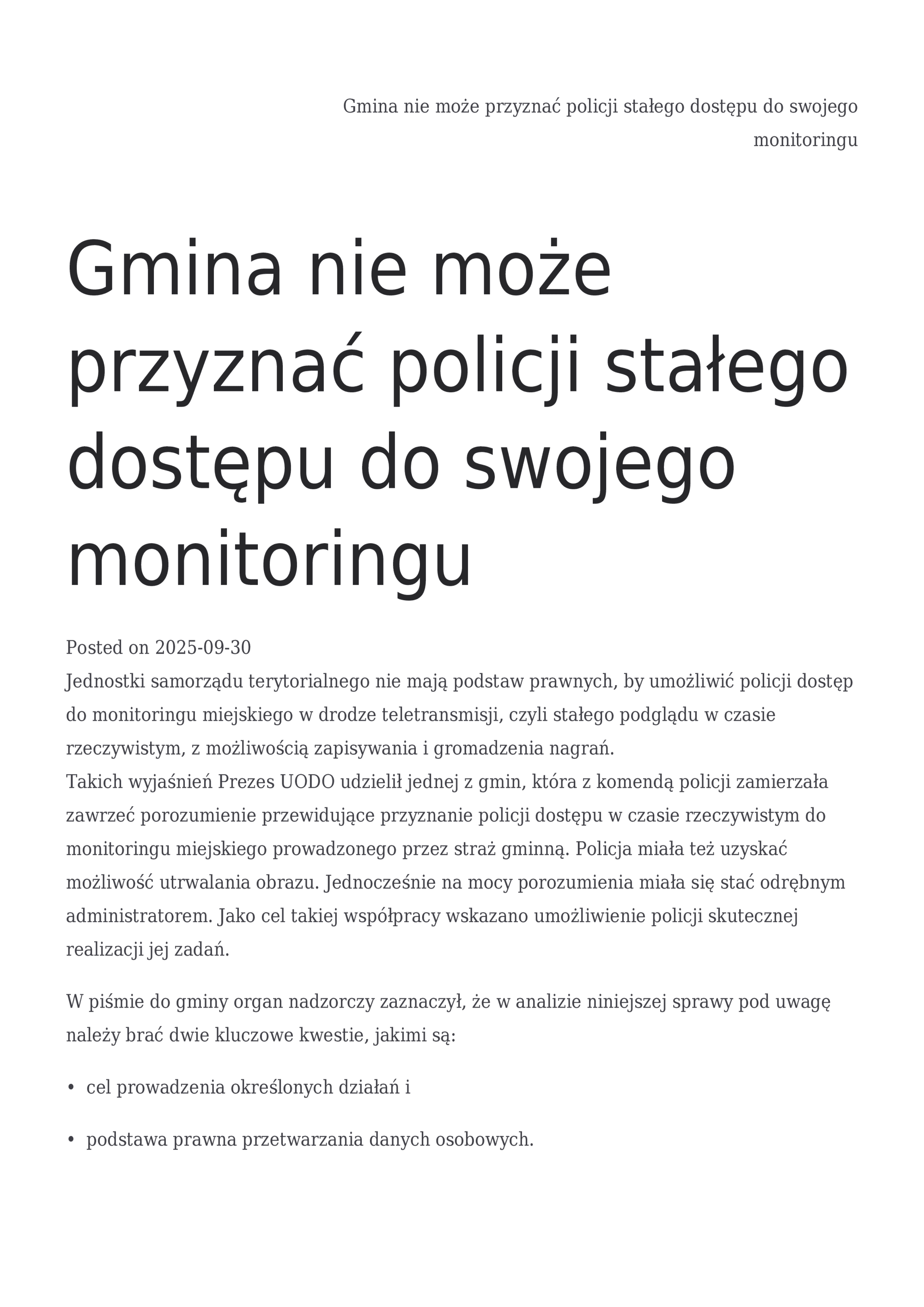
Overview of the Legal Context
The Polish Data Protection Authority (UODO) issued a clear ruling that a municipality (“gmina”) cannot grant the police continuous, live access to its public‑space CCTV system without a specific statutory basis. This decision underscores the principle that ownership of surveillance infrastructure does not automatically confer the right to share real‑time footage with law‑enforcement agencies. The ruling is recorded under the title “Gmina nie może przyznać policji stałego dostępu do swojego monitoringu (UODO, 30 Sept 2025).”
Key Facts of the Decision
- Status: Public, indicating unrestricted accessibility for reference.
- Subtype: Policy Document, classifying it as an official regulatory text.
- AI Generated: No, confirming human‑crafted legal analysis.
- Website: The full text is hosted on the UODO’s official portal (nowybiuletyn.uodo.gov.pl) and can be accessed directly via the provided link.
- Database Submission: Recorded on 2 October 2026 at 5:32 AM, showing recent inclusion in the monitoring database.
- Website Submission: Confirmed as “Yes,” meaning the document was also submitted through the website interface.
Implications for Municipal Surveillance
The ruling clarifies that municipalities retain control over the technical operation of cameras but must seek explicit legislative authorization before transmitting live feeds to police forces. This separation safeguards citizens’ privacy rights while still allowing law‑enforcement to request footage under defined legal procedures, such as court orders or specific emergency provisions.
Relevance to Sustainable Housing Initiatives
For pan‑European stakeholders in sustainable housing, the decision highlights an important governance aspect: the integration of smart‑city technologies, including surveillance, must respect data‑protection norms. Housing projects that incorporate shared camera systems for safety, energy monitoring, or community management need to embed robust legal frameworks that separate data ownership from law‑enforcement access. This ensures compliance with EU‑wide standards like the GDPR and supports public trust in eco‑friendly urban developments.
Data‑Protection Compliance Requirements
- Statutory Basis: Any continuous data sharing with police must be grounded in national legislation or a court‑issued mandate.
- Transparency: Municipalities must publicly disclose the scope of surveillance and the conditions under which data may be accessed.
- Accountability: Regular audits and impact assessments are required to verify that data handling aligns with the authority’s guidelines.
Broader European Context
Similar rulings across EU member states reinforce a consistent approach: while smart‑city infrastructure can enhance sustainability (e.g., optimizing energy use, improving public transport), it must not compromise individual privacy. The UODO decision aligns with the European Court of Justice’s jurisprudence, which stresses proportionality and necessity in surveillance practices.
Practical Steps for Housing Developers
- Legal Review: Conduct a thorough legal audit of any planned CCTV or sensor networks.
- Data Governance Policies: Draft clear policies that delineate who can access live feeds and under what circumstances.
- Stakeholder Engagement: Involve residents early in the design process to explain data‑handling practices and obtain informed consent where required.
- Technical Safeguards: Implement encryption, access logs, and automated data‑deletion protocols to limit unnecessary retention.
Conclusion for Sustainable Housing Stakeholders
The UODO’s ruling serves as a concrete example of how data‑protection law shapes the deployment of digital infrastructure in public spaces. Sustainable housing projects that aspire to integrate advanced monitoring systems must prioritize legal compliance, transparent governance, and resident trust. By doing so, they can achieve the dual goals of environmental efficiency and respect for fundamental privacy rights, setting a benchmark for responsible smart‑city development across Europe.