Overview of the Document
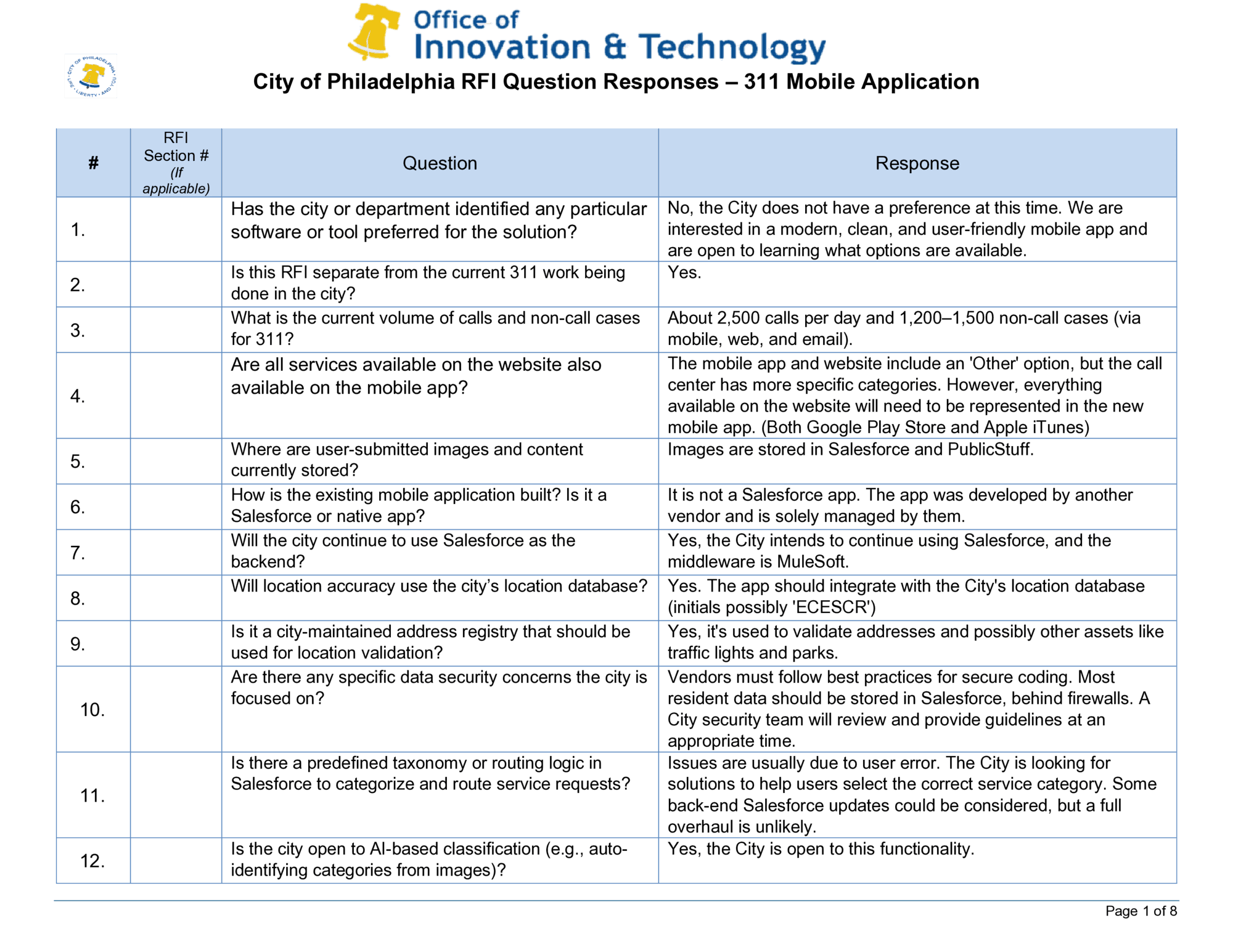
The resource is a question‑and‑answer response compiled by the City of Philadelphia for its 311 Mobile Application initiative. It is publicly available on the official city website and was authored by municipal staff, though individual names are not listed. The document outlines the current 311 service stack—including Salesforce, a vendor‑managed application, and manual duplicate handling—and describes planned improvements, notably a new mobile app that will incorporate AI classification to streamline service requests.
Current 311 System Challenges
The city acknowledges several bottlenecks in its existing 311 ecosystem. Manual duplicate handling remains a known issue, causing delays and inefficiencies in processing citizen reports. Additionally, reliance on multiple platforms such as Salesforce and a vendor‑run app leads to fragmented data management and limited interoperability. These challenges hinder the city’s ability to deliver timely, sustainable services to residents.
Sustainable Housing Implications
Although the document focuses on the 311 service, the information is relevant to sustainable housing initiatives across Europe. Efficient, data‑driven service request handling can accelerate repairs, energy‑saving upgrades, and compliance checks for residential buildings. By reducing response times and eliminating duplicate work, municipalities can allocate resources more effectively toward climate‑friendly retrofits and maintenance of affordable housing stock.
Planned AI‑Enabled Mobile Application
The city’s forthcoming mobile app will integrate artificial intelligence for automatic classification of incoming requests. This technology aims to route issues to the appropriate department instantly, decreasing manual sorting and improving overall system throughput. AI classification also supports better analytics, enabling city planners to identify recurring housing‑related problems—such as heating system failures or insulation deficiencies—and address them proactively.
Expected Benefits for Residents
With the new app, residents can expect a more intuitive reporting experience, faster acknowledgment of submissions, and clearer communication about the status of their requests. For sustainable housing stakeholders, the improved platform offers transparent data on the frequency and types of housing‑related service calls, facilitating evidence‑based policy making and targeted interventions.
Relevance to Pan‑European Audiences
European municipalities seeking to modernize their citizen‑service portals can draw lessons from Philadelphia’s approach. The combination of public transparency, AI‑driven workflow optimization, and a focus on eliminating manual redundancies aligns with broader EU goals for smart, sustainable urban governance. The document provides a concrete case study of how a large city is transitioning toward a more resilient, technology‑enabled service model that supports sustainable housing outcomes.
Key Data and Facts
- Current 311 stack includes Salesforce, a vendor‑run app, and manual duplicate handling.
- AI classification will be embedded in the new mobile application to automate request routing.
- The document is publicly accessible via the city’s official website and was submitted on October 2 2026.
- No individual authors are named; the content is produced by city staff.
- The initiative is part of a broader strategy to improve service efficiency and support sustainable urban development.