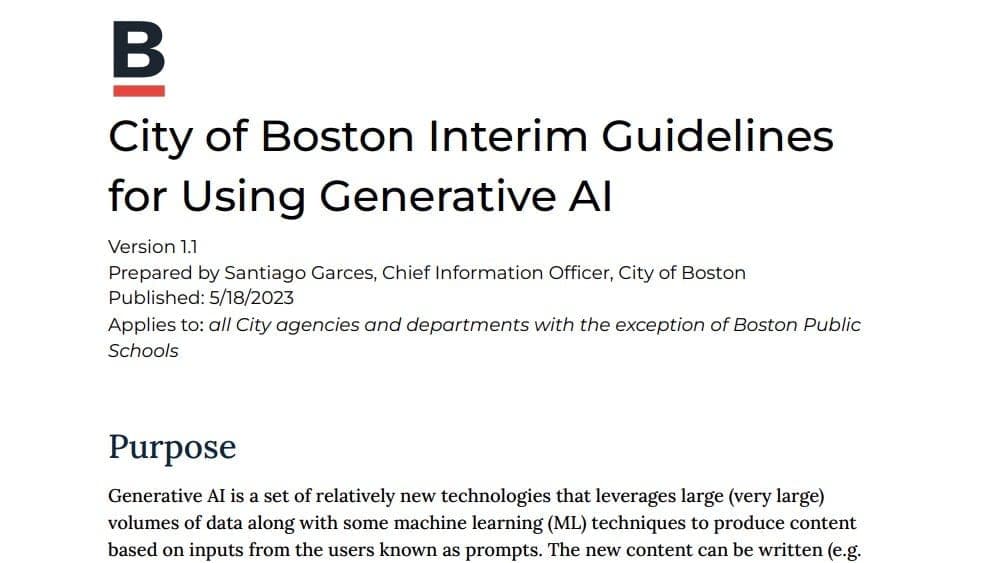
Overview of Boston’s Generative AI Policy
The City of Boston has published a comprehensive Generative Artificial Intelligence (Gen AI) policy that outlines the municipal approach to AI governance. The policy is publicly accessible on the city’s official website and was submitted through an automated SCH profile routine, indicating systematic tracking and transparency in its development.
Policy Development History
The document reflects a multi‑year evolution, beginning with initial guidelines released in 2023, followed by a more detailed policy in 2025, and culminating in the current 2026 revision. Collaboration involved the Northeastern University research team and the American Civil Liberties Union (ACLU), ensuring that both academic expertise and civil‑rights perspectives shaped the framework.
Scope and Applicability
Targeted at all city departments and external contractors, the policy sets standards for the development, deployment, and oversight of generative AI systems used in public services. It addresses risk assessment, data privacy, algorithmic transparency, and accountability mechanisms, aiming to safeguard residents while fostering responsible innovation.
Key Provisions and Requirements
- Risk Management: Mandatory impact assessments for AI projects exceeding defined thresholds of public impact.
- Transparency: Public disclosure of AI system purpose, data sources, and decision‑making logic.
- Bias Mitigation: Regular audits to detect and correct discriminatory outcomes, with remedial actions documented.
- Human Oversight: Requirement that critical decisions retain human review, especially in housing allocation, social services, and law enforcement contexts.
- Data Governance: Strict controls on personal data usage, aligning with Massachusetts privacy statutes and broader U.S. best practices.
Alignment with Sustainable Housing Goals
For a pan‑European audience focused on sustainable housing, the policy’s emphasis on equitable AI‑driven allocation of housing resources is particularly relevant. By mandating bias checks and transparent criteria, the city seeks to prevent discriminatory practices that could exacerbate housing inequality. The framework supports data‑driven planning tools that optimize energy‑efficient building designs and resource distribution, aligning AI use with broader sustainability objectives.
Implementation and Monitoring
The policy establishes an inter‑departmental AI Oversight Committee responsible for continuous monitoring, compliance verification, and periodic public reporting. The committee collaborates with external auditors and academic partners to ensure that AI systems remain aligned with ethical standards and environmental targets.
Measurable Outcomes and Metrics
Boston commits to publishing annual metrics on AI system performance, including:
- Number of AI‑enabled housing projects evaluated.
- Incidence of bias‑related findings and corrective actions taken.
- Energy savings achieved through AI‑optimized building management. These metrics provide a data‑backed basis for assessing the policy’s impact on sustainable urban development.
Access and Further Information
The full policy document is available on the City of Boston’s website at https://www.boston.gov/government/cabinets/innovation-and-technology/city-boston-generative-artificial-intelligence-gen-ai. The submission record indicates it was entered into the city’s database on October 16, 2026, confirming its current public status.