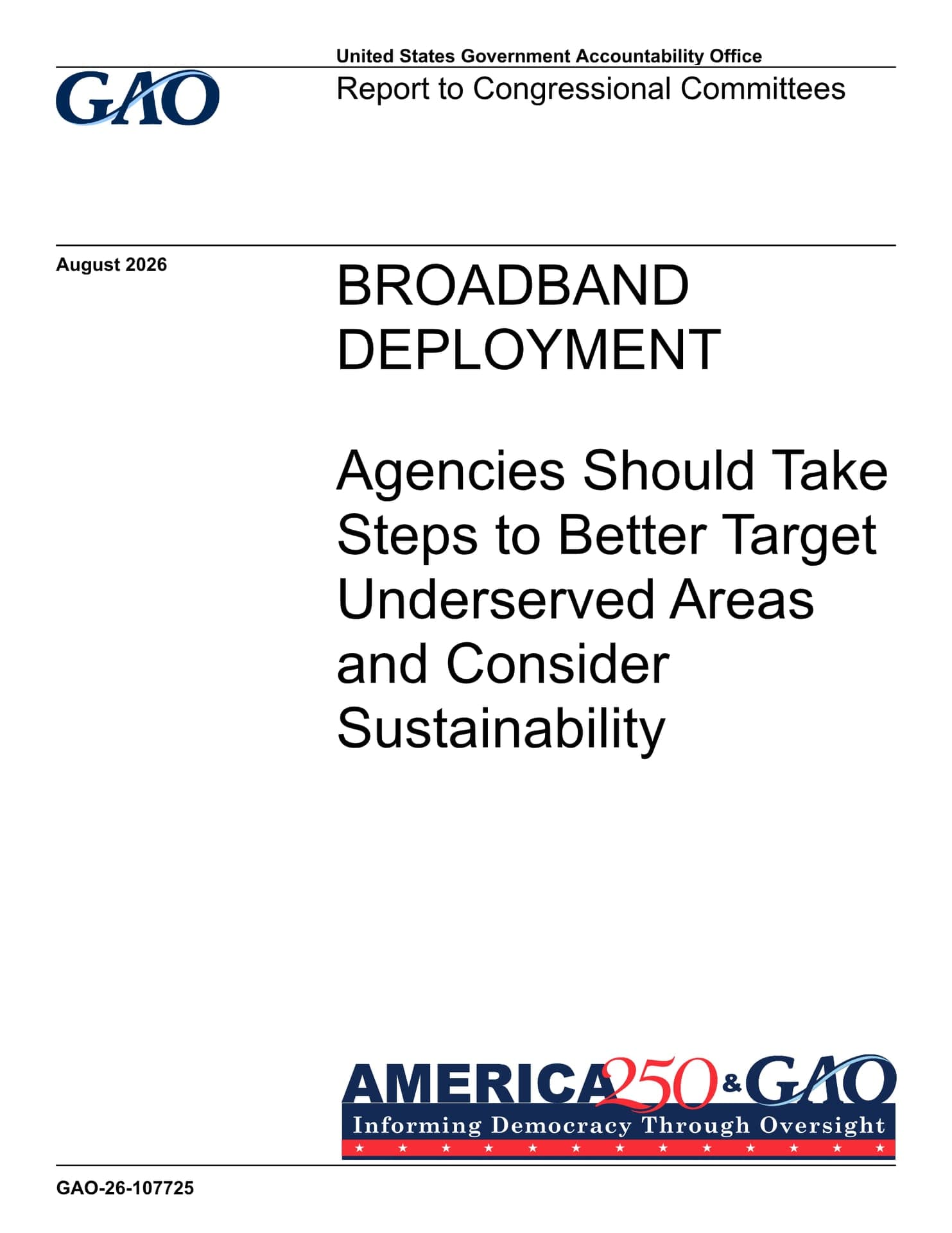
Overview of the GAO Report
The U.S. Government Accountability Office (GAO) released a detailed report titled “Broadband Deployment: Agencies Should Take Steps to Better Target Underserved Areas and Consider Sustainability.” The document analyzes the federal broadband expansion effort known as the Broadband Equity, Access, and Deployment (BEAD) program, focusing on recent policy shifts and funding allocations aimed at improving connectivity in underserved communities.
Key Findings on BEAD Restructuring
The GAO notes that the 2025 BEAD restructuring was substantially altered. Initial plans were rescinded and re‑run, resulting in a reduced emphasis on fiber‑optic deployment. Instead, the program now supports a broader mix of technologies, reflecting a more flexible approach to reaching remote and low‑income households.
Funding Allocation and Scope
The report highlights that $18.4 billion has been awarded to fund broadband projects in approximately 3.8 million locations across the United States. This substantial investment targets areas that have historically lacked reliable high‑speed internet, aiming to close the digital divide and promote economic inclusion.
Sustainability Considerations
While the BEAD program’s primary goal is expanding broadband access, the GAO emphasizes the need for sustainability assessments. The report calls for agencies to evaluate the environmental impact of infrastructure choices, such as the carbon footprint of fiber versus wireless solutions, and to incorporate climate‑resilient designs in future deployments.
Guidance Gaps and Recommendations
The GAO identifies a lack of clear guidance on how leftover funds should be allocated after the initial awards. It recommends that agencies develop transparent criteria for subsequent funding rounds, ensuring that additional resources are directed toward projects that maximize both connectivity and environmental benefits.
Implementation Challenges
Challenges noted include coordination among multiple federal agencies, varying state regulations, and the technical complexities of deploying broadband in rugged or sparsely populated regions. The report suggests streamlined permitting processes and stronger inter‑agency collaboration to overcome these hurdles.
Relevance to Sustainable Housing
For a pan‑European audience interested in sustainable housing, the GAO’s findings illustrate how broadband infrastructure can support energy‑efficient homes. Reliable high‑speed internet enables smart‑home technologies, remote work, and telehealth services, reducing commuting emissions and enhancing overall residential sustainability.
Conclusion and Outlook
The GAO concludes that while significant funding has been committed, the success of the BEAD program depends on targeted outreach to underserved areas, robust sustainability assessments, and clear guidance for future fund distribution. Ongoing monitoring and adaptive policy measures are essential to ensure that broadband expansion contributes to both digital equity and environmental stewardship.