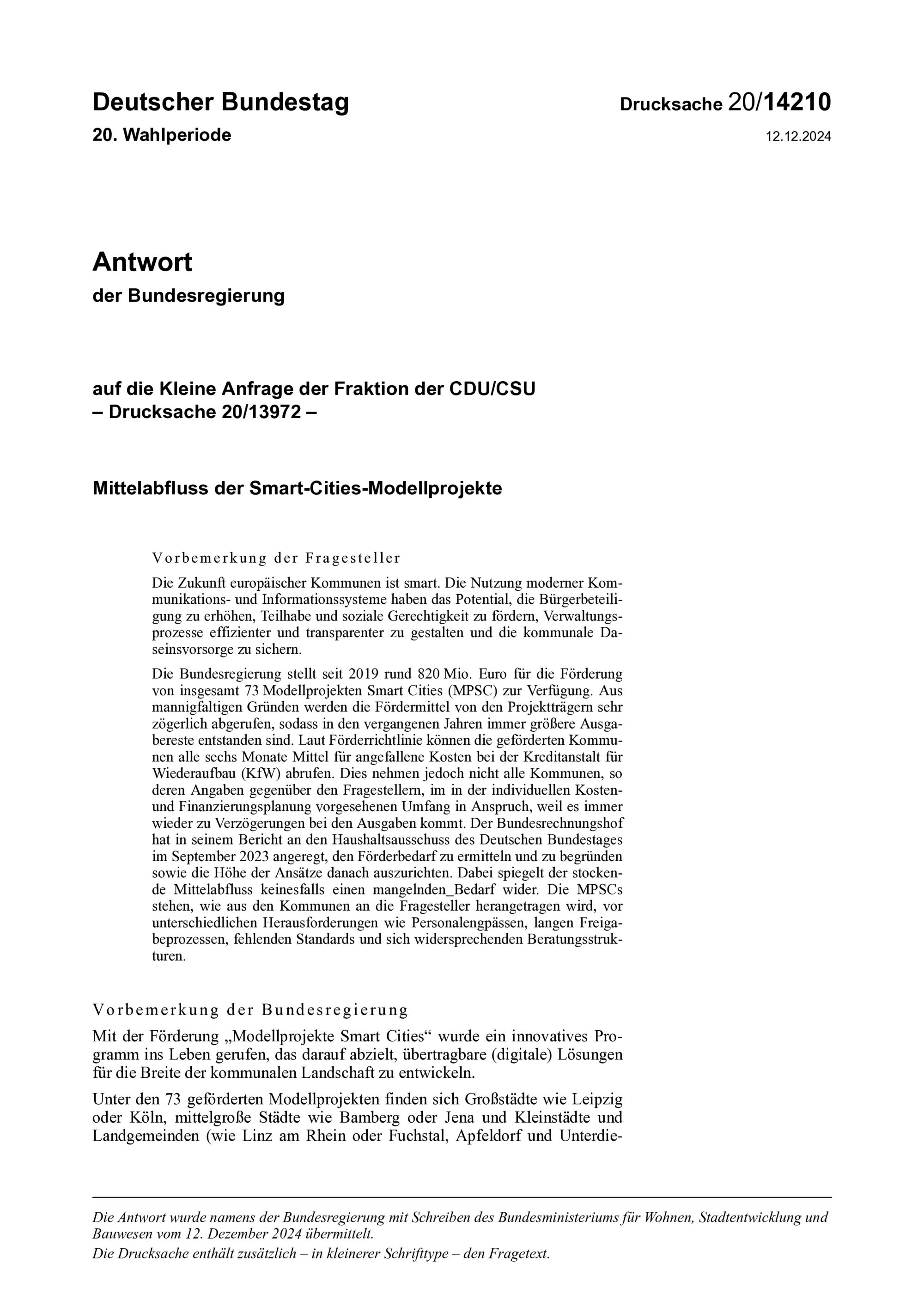

Overview of the Federal Report
The document titled “Antwort der Bundesregierung: Mittelabfluss der Smart‑Cities‑Modellprojekte (BT‑Drucksache 20/14210)” is an official response from the German Federal Government concerning the disbursement of funds for Smart‑Cities pilot projects. It is a policy document submitted publicly and generated without AI assistance. The publication is hosted on the Bundestag’s digital server and has been indexed for national‑strategy‑politics research.
Funding Allocation and Drawdown
According to the report, €146 million out of a total €691 million earmarked for 73 Smart‑Cities model projects had been drawn down by November 2024. This represents roughly 21 % of the committed budget. The remaining funds are still pending allocation, indicating an ongoing rollout of financial support for urban innovation.
Scope of the 73 Model Projects
The Smart‑Cities model projects span a variety of German municipalities and focus on integrated, technology‑driven solutions for urban challenges. Key areas include energy‑efficient building retrofits, renewable energy integration, digital infrastructure for mobility, and data‑driven management of public services. The projects aim to create replicable templates for sustainable urban development.
Transfer of Solutions to Non‑Funded Towns
The report highlights that a portion of the solutions developed within the funded projects has already been transferred to towns that did not receive direct funding. This diffusion mechanism is intended to accelerate the spread of best practices across the country, fostering broader impact on sustainable housing and urban resilience.
Measured Outcomes and Indicators
The government’s own figures, cited in the document, track progress through quantitative indicators such as the amount of capital drawn, the number of projects implementing energy‑saving measures, and the reduction in CO₂ emissions attributable to pilot interventions. These metrics provide a baseline for evaluating the effectiveness of the Smart‑Cities initiatives.
Relevance for Pan‑European Sustainable Housing
For a European audience interested in sustainable housing, the German experience offers valuable insights into large‑scale public financing, coordinated project management, and the scaling of innovative solutions. The emphasis on retrofitting existing building stock aligns with EU objectives to improve energy performance of the built environment. Moreover, the approach of sharing successful interventions with non‑funded municipalities demonstrates a pathway for knowledge transfer across borders.
Key Technical Measures Implemented
Among the technical measures reported are: installation of heat‑pump systems, integration of smart meters, deployment of district heating networks powered by renewable sources, and the use of building information modeling (BIM) for planning renovations. These interventions collectively contribute to lower energy consumption and enhanced occupant comfort.
Future Outlook and Monitoring
The document notes a refresh cycle slated for the fourth quarter of 2026, indicating that the government will update the data and assess further progress. Continuous monitoring is planned to ensure that the remaining €545 million is allocated efficiently and that the outcomes align with national sustainability targets.
Access and Documentation
The full text is accessible via the Bundestag’s digital server, providing transparency and allowing stakeholders to examine detailed project descriptions, financial tables, and methodological notes. The availability of this data supports evidence‑based policy making and encourages comparative analysis with other European Smart‑City initiatives.