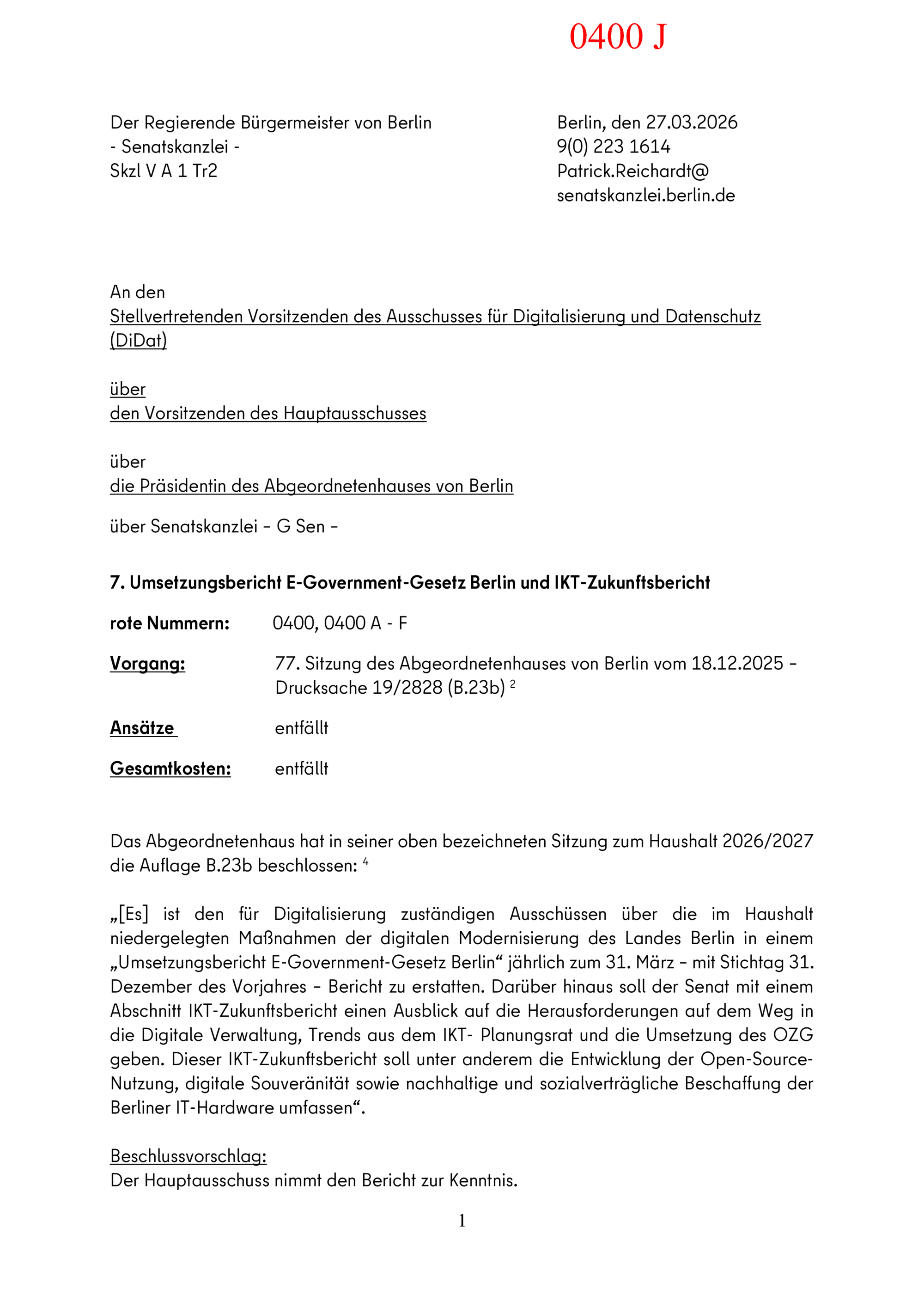

Overview of the Report
The document is the seventh implementation report on the E‑Government Law for Berlin, prepared by the Senate Chancellery (Senatskanzlei Berlin). The report is authored by State Secretary Matthias Hundt, who oversees digital transformation and administrative modernization for the Governing Mayor’s office. It presents the status of Berlin’s digital initiatives as of March 2026, summarizing progress, challenges, and future plans across a wide range of e‑government projects.
Scope and Structure
Spanning 163 pages, the report combines a detailed implementation review with an “IKT Future Report” that outlines upcoming trends, open‑source strategies, and sustainable procurement for Berlin’s IT hardware. It is organized into thematic sections covering project‑management platforms, cybersecurity services, smart‑city pilots, and inter‑ministerial cooperation agreements. Each section lists project identifiers, budget allocations, and timelines up to the end of 2025.
Key Performance Figures
- e‑File usage: Approximately 3,600 active users across 40 authorities, far below the target of 60,000 users, highlighting a significant gap between ambition and delivery.
- Budget: The overall budget for the reported measures totals € 4.5 million (as cited in the properties).
- Project count: Over 150 individual measures are catalogued, with 82 pages dedicated to the Project‑Management‑Platform Berlin (ProMaP) and 122 pages to the IKT‑Base‑Service “IKT‑Security and Data‑Protection” (Berlin‑CERT).
- Digital services: The report confirms the completion of the electronic residence registration (“eWA Berlin”) and the rollout of digital issuance for passports and ID cards, with further services slated for Q4 2025.
Institutional Context
The Senate Chancellery coordinates Berlin’s digital agenda, linking ministries, district administrations, and the central IT Service Center (ITDZ Berlin). Matthias Hundt, as State Secretary for Digitalisation, is responsible for steering these cross‑departmental efforts, ensuring compliance with the federal E‑Government Law (OZG) and the Berlin‑specific legislative framework (EGovG Bln). The report is publicly accessible and was submitted to the parliamentary database on 1 October 2026.
Sustainability and Procurement
A distinct focus of the “IKT Future Report” is sustainable and socially responsible procurement of IT hardware. The document outlines criteria for eco‑design, energy efficiency, and circular economy principles in hardware acquisition, aligning Berlin’s digital strategy with broader European sustainability goals.
Inter‑Agency Cooperation
The report details a cooperation agreement on cyber‑ and information‑security between the Senate’s Digitalisation department and the Ministry of the Interior. It also references collaboration with the Federal IT Planning Council (IT‑Planungsrat) on standards for open data, data sovereignty, and the development of a Berlin‑wide data hub.
Future Outlook
Projected milestones include:
- Expansion of the e‑file user base to reach a broader citizen audience by 2027.
- Completion of the IKT‑Base‑Service “Digital Document Box” rollout, with a target of 60,000 users.
- Implementation of a digital twin concept and a metadata catalog for administrative data by Q4 2026.
- Finalization of the Open‑Source Strategy and the Multi‑Cloud Strategy, supporting digital sovereignty and resilience.
Monitoring and Governance
The report introduces a traffic‑light status system (green, yellow, red) to assess project health based on timeline, quality, and budget adherence. It also establishes a Digitalisation Dashboard for real‑time monitoring of service delivery, with 15,867 active entries as of 29 December 2025, of which 7,714 are fully assigned to Berlin’s administrative units.
Access and Availability
The full report is available online through the Berlin Parliament’s document portal. It is classified as “Public” and “Completed,” indicating that it has passed all internal review stages and is ready for public consumption. The AI‑generated tag confirms that portions of the text were produced with automated assistance, reflecting Berlin’s commitment to leveraging advanced technologies in its documentation processes.