Overview of the Document
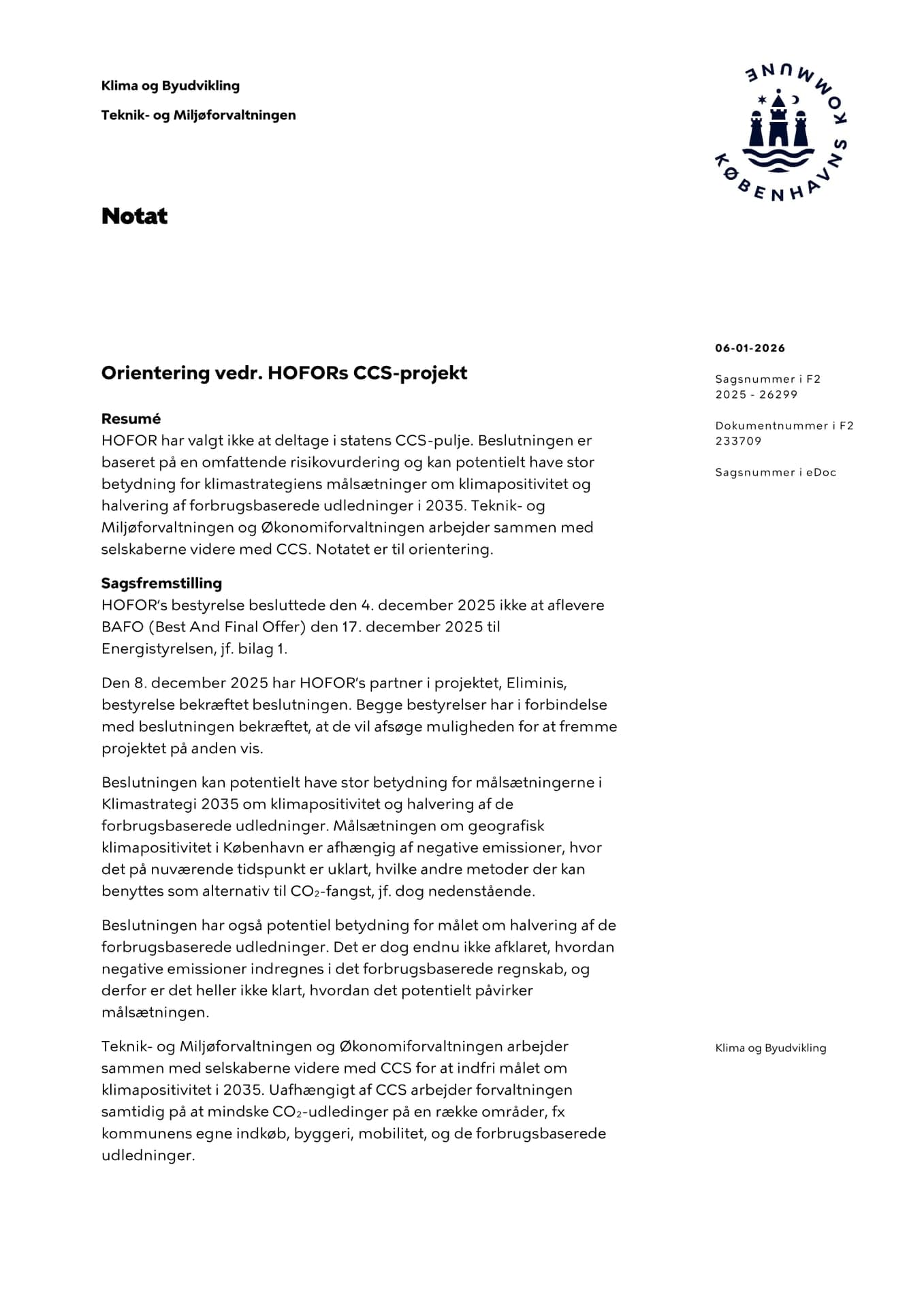
The resource is an informational note titled “Orientering vedr. HOFORs CCS‑projekt,” issued by the Technical and Environmental Administration of the City of Copenhagen. It outlines the city’s carbon capture and storage (CCS) initiative involving the utility company HOFOR, providing policy context, project status, and implications for Copenhagen’s climate targets.
Context and Policy Background
Copenhagen aims to become climate‑positive by 2035, and CCS is a central component of its strategy to reduce residual CO₂ emissions from the energy and heating sectors. The note explains that the city’s second CCS bid was withdrawn from the state tender, creating uncertainty for meeting the 2035 goal. This development is highlighted as a risk factor for the city’s overall climate plan.
Key Project Details
- Status: Public
- Subtype: Policy Document
- AI Generated: No
- Primary Link: https://www.kk.dk/sites/default/files/2026-01/06.01.26%20-%20Orienteringsnotat%20om%20HOFORs%20CCS-projekt.pdf
- Submission Date: October 16 2026 (2:23 PM) The document notes that HOFOR’s CCS project was intended to capture CO₂ from existing fossil‑fuel‑based heating infrastructure and store it underground, thereby lowering the city’s carbon footprint.
Data and Figures
While the note does not provide extensive quantitative data, it emphasizes that the withdrawal of the state tender jeopardizes the projected CO₂ reduction pathway. The city’s climate‑positive target relies on achieving a significant share of emissions reductions through CCS, alongside renewable energy expansion and energy efficiency measures.
Stakeholder Involvement
The Technical and Environmental Administration coordinates with HOFOR, national authorities, and the broader municipal climate strategy team. The document is cited within the city’s strategic debate platform (city/copenhagen §strategy‑politics‑debate) and is auto‑approved under the tenant library‑promotion policy, indicating institutional endorsement.
Implications for Sustainable Housing
For a pan‑European audience focused on sustainable housing, the CCS setback signals potential delays in decarbonizing district heating systems that serve residential buildings. Without CCS, the city may need to accelerate alternative low‑carbon heating solutions, such as heat pumps, renewable‑based district heating, or retrofitting insulation. The note underscores the interconnectedness of energy supply, housing policy, and climate objectives.
Next Steps and Recommendations
The city plans to reassess the CCS pathway, explore alternative funding mechanisms, and strengthen collaboration with national stakeholders to keep the climate‑positive timeline on track. Continued monitoring of the CCS project’s status and its impact on residential heating will be essential for achieving sustainable housing goals across Europe.