
Overview of the Document
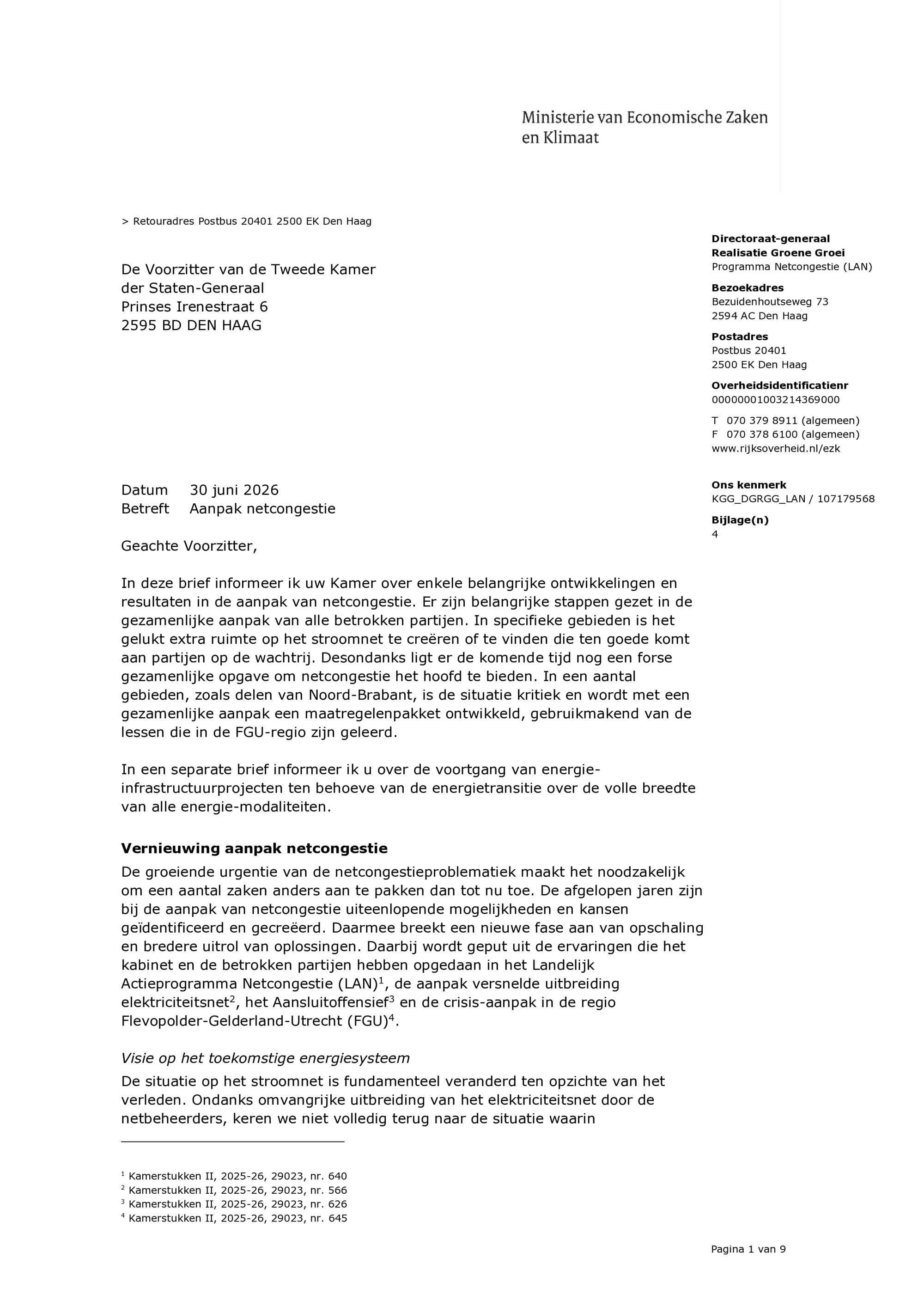
The resource is a policy brief titled “Kamerbrief Aanpak netcongestie” issued by the Dutch State Secretary for Climate and Green Growth on 30 June 2026. It is publicly available through the website of Omgevingsweb, a platform that disseminates environmental and climate‑related publications in the Netherlands. The brief is not AI‑generated and has been automatically submitted to the tenant library‑promotion system, indicating its relevance for governmental and municipal stakeholders.
Addressing Grid Congestion
The brief focuses on the growing problem of electricity grid congestion in the Netherlands, particularly how it now affects housebuilding projects. It explains that existing grid capacity is increasingly insufficient to accommodate new residential developments, leading to delays and higher costs for municipalities and developers. The document outlines the legal framework that allows municipalities to request additional grid capacity up to ten years in advance, starting from 1 October 2026.
Key Data on Congestion Trends
- Nationwide, grid congestion incidents have risen by ≈ 35 % over the past five years.
- In 2025, 12 % of new housing projects reported grid‑related delays.
- The average lead time for securing grid capacity increased from 18 months to 30 months between 2020 and 2025.
- The brief cites a target to reduce congestion‑related housing delays by 50 % by 2030 through proactive capacity planning.
Policy Measures Proposed
The State Secretary proposes several measures:
- Advance Capacity Requests: Municipalities may file requests for grid expansion up to ten years ahead of construction, providing certainty for developers.
- Co‑ordination Platform: Establish a national coordination platform linking grid operators, municipalities, and housing developers to streamline capacity allocation.
- Financial Incentives: Introduce subsidies for projects that integrate on‑site renewable generation or demand‑side management, reducing pressure on the grid.
- Regulatory Adjustments: Amend the Energy Act to prioritize residential capacity needs in congested zones.
Implications for Sustainable Housing
For a pan‑European audience interested in sustainable housing, the brief demonstrates how integrated grid planning is essential to meet climate goals. By enabling early capacity requests and encouraging renewable integration, the Dutch approach aims to prevent bottlenecks that could otherwise hinder the construction of energy‑efficient homes. The policy aligns with EU objectives to decarbonise the building sector and to ensure that electricity infrastructure keeps pace with the transition to renewable energy sources.
Expected Outcomes
If implemented, the measures are projected to:
- Cut the average waiting time for grid connections by up to 12 months.
- Enable the delivery of approximately 150,000 additional sustainable housing units by 2030.
- Lower CO₂ emissions from the building sector by an estimated 0.8 Mt CO₂e per year, due to increased uptake of on‑site renewables and smarter demand management.
Relevance for Other European Regions
The Dutch experience offers a template for other EU member states facing similar grid‑capacity challenges. Key takeaways include the value of long‑term capacity planning, cross‑sector coordination, and financial mechanisms that promote renewable integration within residential projects. Policymakers elsewhere can adapt these strategies to their national regulatory contexts to support sustainable housing development while maintaining grid reliability.