Overview of the Executive Order
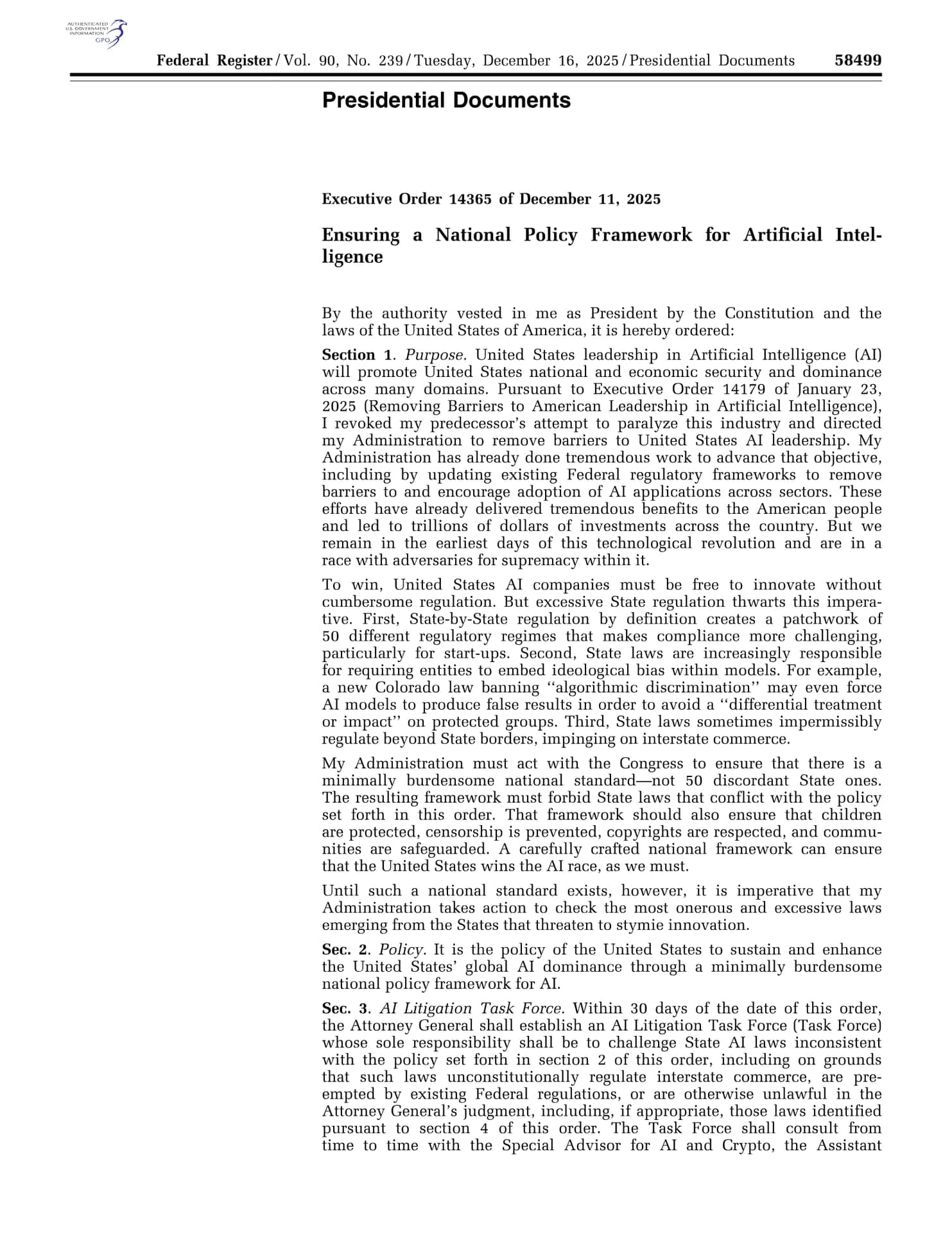
Executive Order 14365, issued on 11 December 2025, establishes a national policy framework for artificial intelligence (AI) in the United States. It is a public, non‑AI‑generated policy document, formally titled “Executive Order 14365: Ensuring a National Policy Framework for Artificial Intelligence.” The order was submitted to the White House website and recorded in the database on 16 October 2026.
Policy Intent and Scope
The order aims to create a coordinated federal approach to AI development, deployment, and regulation. It seeks to pre‑empt fragmented state laws that could hinder a unified national strategy, while still allowing state and local governments to procure and use AI for their own purposes. By linking AI policy to broadband funding, the order ties technological advancement to broader infrastructure goals.
Key Provisions and Data
- National Framework: Establishes a central AI coordination office within the Executive Office of the President.
- Funding Linkage: Connects AI policy compliance to eligibility for federal broadband assistance, incentivising states to align with the national framework.
- State Autonomy: Permits state and local entities to adopt AI solutions for public services, provided they adhere to baseline federal standards.
- Compliance Timeline: Requires all federal agencies to submit AI inventories and risk assessments by Q2 2027.
Relevance to Sustainable Housing
Although the order focuses on AI, its emphasis on broadband and data‑driven governance has direct implications for sustainable housing across Europe. AI‑enabled energy management systems, predictive maintenance, and smart‑grid integration can reduce carbon footprints in residential buildings. By standardising AI use and linking it to infrastructure funding, the order models how governments can promote tech‑driven sustainability initiatives. European policymakers can draw lessons on aligning digital transformation with climate‑friendly housing strategies.
Implementation Mechanisms
The order mandates inter‑agency collaboration, requiring the Department of Housing and Urban Development (HUD) to work with the Office of Science and Technology Policy (OSTP) on AI applications in housing. It also calls for public‑private partnerships to develop open‑source AI tools for building performance analytics.
Submission and Review Process
The document’s “Database Submission” timestamp is 16 October 2026 3:23 PM, and the website confirms the submission status as “Yes.” The content was auto‑approved under the tenant library‑promotion policy, indicating a streamlined review cycle scheduled for 2026‑Q4.
Transparency and Accessibility
The full text is publicly available on the White House website (https://www.whitehouse.gov/presidential-actions/2025/12/eliminating-state-law-obstruction-of-national-artificial-intelligence-policy/). The order’s metadata lists its subtype as “Policy Document,” confirms it was not AI‑generated, and records its public status.
Implications for Future Policy Development
By centralising AI governance while preserving state flexibility, the order sets a precedent for harmonising technology policy with sector‑specific goals, such as energy efficiency in housing. European unions may consider similar frameworks to ensure that AI supports, rather than complicates, sustainable building standards and climate targets.