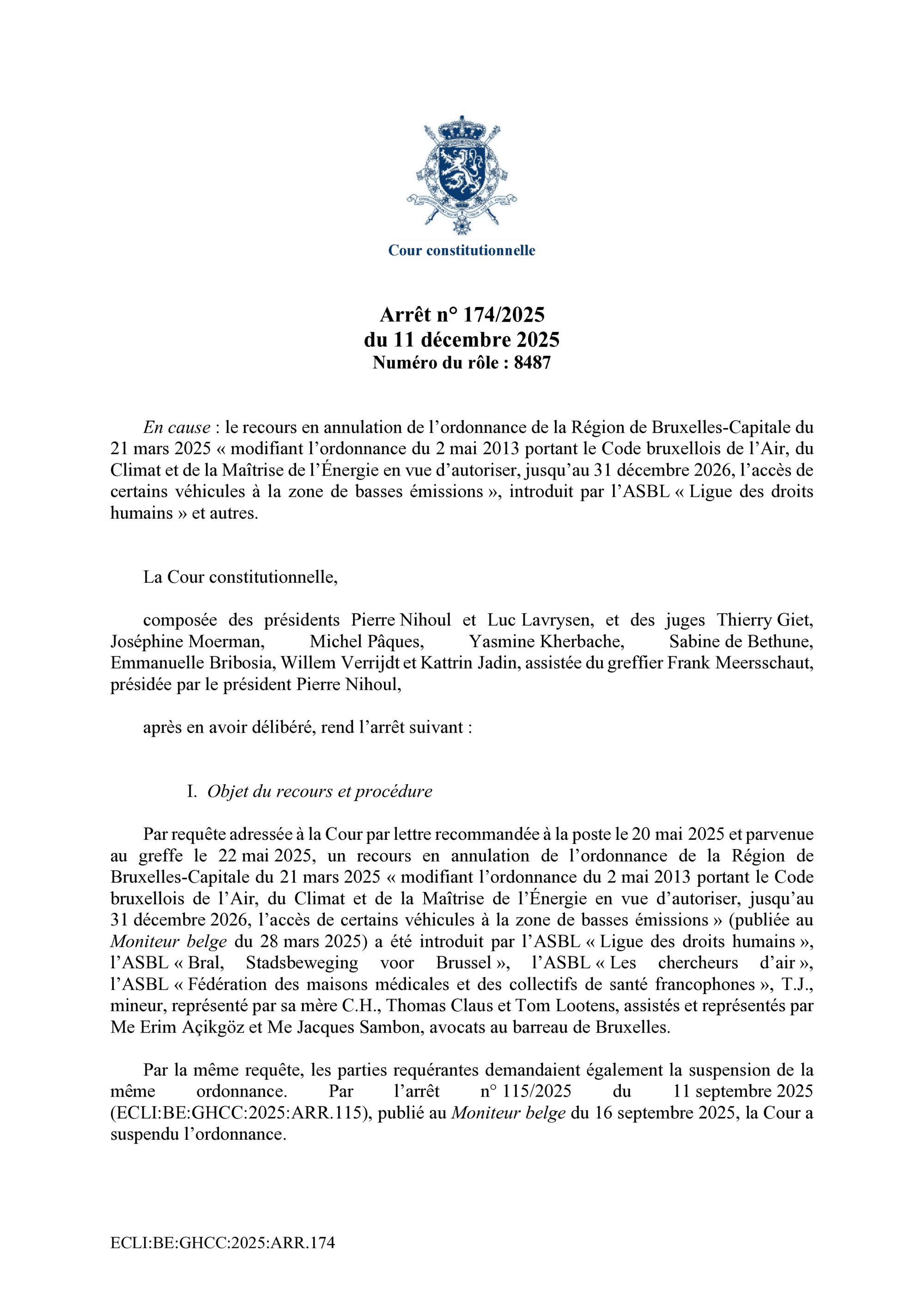

Overview of the Ruling and Its Legal Basis
The Constitutional Court of Belgium issued judgment No 174/2025, annulling the Brussels Region’s decision to postpone the implementation of the low‑emission zone (LEZ). The court ruled that the postponement violated the constitutional right to health, emphasizing that environmental measures must be upheld to protect public well‑being. The decision was supported by civil‑society groups including BRAL and the Ligue des droits humains, which argued that the delay undermined climate‑friendly mobility policies.
Institutional Context and Parties Involved
The judgment originates from the French‑language division of the Belgian Constitutional Court, the highest authority for reviewing the constitutionality of regional legislation. The case was brought forward by a coalition of NGOs and citizen groups concerned with air quality and sustainable urban transport. The court’s decision reflects a broader European trend of judicial bodies enforcing climate‑related rights and holding governments accountable for environmental commitments.
Impact on Brussels’ Low‑Emission Zone Strategy
By striking down the postponement, the ruling obliges the Brussels Region to proceed with the LEZ as originally scheduled. The LEZ aims to reduce particulate matter and nitrogen‑oxide emissions by restricting access to the most polluting vehicles in the city centre. Implementation is expected to improve air quality, contribute to the EU’s Green Deal targets, and set a precedent for other metropolitan areas seeking to tighten emission standards.
Relevance for Sustainable Housing and Urban Planning
The enforcement of the LEZ directly affects residential districts within the zone, encouraging a shift toward cleaner transport options and lower exposure to harmful pollutants for inhabitants. Sustainable housing initiatives can leverage this regulatory environment by integrating electric vehicle charging infrastructure, promoting car‑free zones, and aligning building energy performance with broader city‑wide emission reduction goals.
Key Data and Figures from the Decision
- The court cited health‑related constitutional provisions as the primary legal basis.
- Civil‑society partners highlighted measurable health risks associated with delayed LEZ implementation, referencing local air‑quality monitoring data.
- The ruling reinforces the Brussels Region’s commitment to meet EU emission reduction benchmarks for 2030.
Implementation Timeline and Next Steps
Following the judgment, the Brussels administration must finalize technical and administrative measures to enforce the LEZ without further delay. This includes updating traffic monitoring systems, issuing permits for compliant vehicles, and establishing penalties for violations. Municipal authorities are expected to coordinate with transport operators, urban planners, and housing developers to ensure an integrated approach.
Implications for European Sustainable Mobility Policies
The case exemplifies how constitutional courts can serve as catalysts for climate action, reinforcing the legal enforceability of sustainable mobility measures across the EU. It underscores the importance of aligning regional policies with European climate objectives and provides a reference point for other jurisdictions contemplating similar low‑emission initiatives.