Sweden
The Quiet Architects of Urban Intelligence
Sweden rarely shouts about its smart city ambitions, yet it has built one of Europe's most sophisticated ecosystems for urban innovation — quietly, methodically, and with a determination to link every digital intervention to a climate outcome. With a population of around 10.5 million spread across a vast, sparsely settled geography, the country faces a distinctive challenge: how to make urban technology work not only in dense capitals but also in mid-sized towns and Arctic municipalities where connectivity and scale are harder to come by.
The conversation has shifted markedly in recent years. Where earlier Swedish smart city efforts focused on individual pilot projects, the national discourse now centres on systemic transition — what policymakers call the Twin Transition, the deliberate coupling of climate action and digitalisation. In October 2025, the government published A New Strategy for Vibrant and Safe Cities, setting out a fresh urban development agenda. Months earlier, in May 2025, the Ministry of Finance released Sveriges digitaliseringsstrategi 2025–2030, a national digital strategy organised around five pillars: digital competence, business digitalisation, public administration, welfare, and connectivity — with artificial intelligence, data, and security as cross-cutting themes. Together, these documents signal that Sweden sees the smart city not as a standalone project but as the urban expression of a broader national transformation.
A Government That Governs Through Missions
Sweden's political landscape has long favoured consensus-driven innovation policy, and smart city governance reflects this. The most powerful instrument is Viable Cities, a strategic innovation programme funded jointly by the Swedish Energy Agency, Vinnova — Sweden's Innovation Agency (Sweden's innovation agency, with an annual budget of roughly 3.5 billion SEK), and Formas, and coordinated by KTH Royal Institute of Technology. Viable Cities operates on a mission model: its goal is climate-neutral cities by 2030, with a good life for all within planetary boundaries.
The programme's signature mechanism is the Climate City Contract — a voluntary but structured agreement between a municipality, national agencies, and Viable Cities committing all parties to co-develop climate action plans and investment strategies. By late 2024, 48 of Sweden's 290 municipalities had signed on, collectively representing half the country's population. Among them are Stockholm, Gothenburg, Malmö, Uppsala, Umeå, and Lund, but also smaller cities like Kalmar and Växjö, signalling that the programme is not a metropolitan club. "The initiative has evolved continuously, but its objectives and the holistic nature of the projects are highly relevant in the context of the EU Cities Mission," noted the European Commission's The State of European Smart Cities: Exploring and showcasing models, solutions, and financing for European replication to achieve climate neutrality report, which highlighted Gothenburg's Climate Partnership as a model for public-private collaboration on urban decarbonisation.
Yet not everyone is convinced. A peer-reviewed study published in Cities asked bluntly whether Sweden's climate-neutral city pledges amount to "true commitment or hollow statements." The researchers observed that while 23 cities (at the time) had signed climate city contracts, "concrete targets for emission reductions in each city are yet to be defined." The criticism is not that the ambition is wrong, but that without binding metrics and adequate funding, mission rhetoric risks outpacing delivery.
Where Power Sits: Sweden's Innovation Machinery
Sweden's smart city ecosystem is unusually distributed. Stockholm is the gravitational centre, home to the Kista ICT cluster — one of Europe's densest concentrations of technology firms, with over 100,000 employees across more than 40,000 businesses — and to the City of Stockholm's own innovation directorate, which describes its work as "closely linked to operational and quality development, as well as the use of AI and digitalization as tools to achieve the goal of becoming a smart and connected city." But Gothenburg, Malmö, Lund, and Umeå each anchor significant clusters of their own.
The research infrastructure is formidable. KTH Royal Institute of Technology — SPHERE Smart Cities runs a strategic research effort spanning smart energy systems, transport, and digital infrastructure. At Chalmers University of Technology in Gothenburg, the Digital Twin Cities Centre (DTCC), funded by Vinnova, aims to make Sweden a world leader in urban digital twins by 2030 — a goal that connects directly to the European Commission's Digital Twins for Smart Cities research agenda. In late 2023, Vinnova committed SEK 20 million to the Urban Twin Transition Center (UTTC), led by the Swedish Internet Foundation with the University of Gothenburg and RISE (Research Institutes of Sweden), to help municipalities use digital tools for climate planning.
RISE itself occupies a distinctive niche. As Sweden's state-owned research institute, it bridges academia and municipal practice. But RISE researchers have also been among the most candid critics of Sweden's progress. In a widely read analysis, RISE noted that while Sweden is far ahead in digitalisation, it lags behind in open city data — a paradox in a country that prides itself on transparency. Municipalities, RISE argued, need better data strategies if they are to move from isolated pilots to integrated smart city platforms.
Smart City Sweden, a state-funded export platform managed by IVL Swedish Environmental Research Institute, operates six regional offices welcoming international delegations. Its role is to showcase Swedish smart city solutions abroad, but it also functions as a domestic mirror, curating and cataloguing what Swedish cities have actually built. Meanwhile, Team Sweden Smart Cities, coordinated through Viable Cities, promotes international investment partnerships for green and digital urban transition.
From Blueprints to Buildings: What Sweden Has Actually Deployed
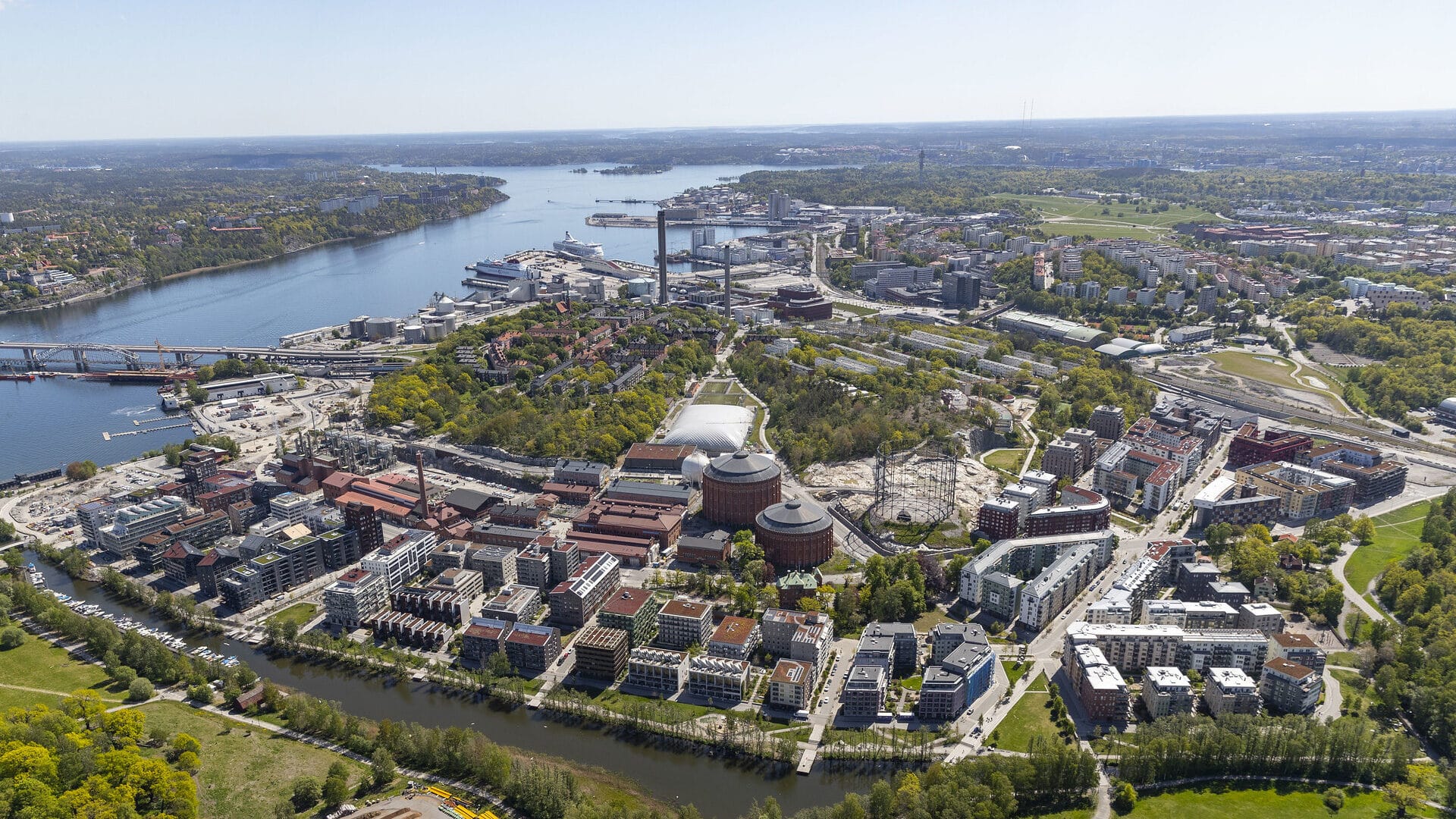
The country's marquee urban development is Stockholm Royal Seaport (Norra Djurgårdsstaden), Stockholm's largest regeneration project: 12,000 new homes and 35,000 workplaces on former industrial land, designed to be climate-positive by 2030. The district deploys a smart grid connecting buildings to a shared energy management system, pneumatic waste collection removing the need for conventional refuse trucks, and granular environmental monitoring across construction phases. It is not merely a green neighbourhood; it is a full-scale test bed for how data, energy, and urban design can be integrated from the ground up.
Gothenburg, Sweden's second city, has pursued a different path — emphasising industrial decarbonisation and port logistics alongside residential innovation. Its Climate Partnership, highlighted by the The State of European Smart Cities: Exploring and showcasing models, solutions, and financing for European replication to achieve climate neutrality, brings together the business community and the city government in a long-term collaboration to reduce carbon emissions, offering companies access to key municipal actors and support for sustainability projects.
At the building scale, Stockholm University and property developer Atrium Ljungberg are collaborating on AI-driven digital twins for smart buildings in Kista's Nod complex, using machine learning to optimise energy use, indoor climate, and predictive maintenance. In transport, the Drive Sweden programme has tested autonomous shuttles and AI-powered traffic management in Stockholm's streets, while the national road authority, Trafikverket, is piloting connected vehicle corridors on major motorways. SKR, the Swedish Association of Local Authorities and Regions, has published a Digital Development Strategy to help municipalities navigate the shift from analogue to data-driven governance.
Fika, Cycling, and the Smart City You Don't Notice
For all its institutional machinery, Sweden's most telling smart city experiences are the ones residents barely think about. Stockholm's SL public transport app, used by millions of commuters daily, integrates real-time departure data, disruption alerts, and contactless payment — a seamless layer of digital convenience over one of Europe's most extensive metro and bus networks. In Gothenburg, the ElectraCity electric bus fleet runs on renewable energy along the city's busiest routes, monitored by real-time energy dashboards. In Malmö, residents in the Hyllie district live inside what is effectively a smart energy community, with buildings connected to a shared heat and cooling grid optimised by algorithms.
These experiences connect to a cultural habit that is as Swedish as ABBA: fika, the daily coffee break that structures social life in homes, offices, and public spaces. Fika is, at its heart, an exercise in pause — a collective decision to slow down, connect, and reflect. It is a quiet rebuke to the frenetic pace that technology often imposes. And it may be the most instructive thing Sweden has to offer the smart city conversation: the reminder that urban intelligence is not about speed or spectacle, but about creating conditions for a good life. The Nordic smart city model is recognised internationally precisely because it measures success not in sensors deployed but in quality of life delivered.
"Cities need data to become smart," RISE has argued. True enough. But Sweden's experience suggests they also need patience, institutional depth, and a willingness to ask hard questions about whether the data is actually serving people — preferably over a cup of coffee.
References6 resources14 external