Loading...
City
Lisbon
Country🇵🇹 Portugal
The Sunlit Laboratory
Lisbon was not supposed to become a tech city. A decade ago, Portugal's capital was still recovering from the sovereign debt crisis, its economy fragile, its young talent emigrating. Then came the Web Summit in 2016, and with it a narrative shift that Lisbon's leadership seized with both hands. Today, the city of 546,000 — modest in population but vast in ambition — has transformed itself into one of southern Europe's most dynamic innovation ecosystems, where smart city experimentation is woven into a broader story of urban reinvention.
The municipality and NOVA IMS (the information management school of Universidade Nova de Lisboa) are now developing the Lisboa Inteligente 2030 strategy, a comprehensive plan that addresses Lisbon's most pressing urban challenges — housing, mobility, environment, economy, and governance — through integrated technology and data. The strategy involves detailed diagnostics and the creation of specific action plans for each municipal unit, an approach that recognises the smart city cannot be a single department's project but must reshape how the entire administration works.
Lisbon's existing smart city platform, Lisboa Inteligente, already provides residents with real-time information through a dedicated app — emergency occurrences, traffic restrictions, parking availability, and bike-sharing — drawing from the city's Intelligent Management Platform. It is a practical tool, not a showcase, and its integration into daily life reflects Lisbon's approach: technology should solve problems people actually have.
From Austerity to Ambition
Lisbon's political leadership has embedded smart city innovation within a broader urban development strategy that commits €307 million to related projects under the Programa Operacional Regional de Lisboa 2020. The strategy's objectives are characteristically pragmatic: attract more inhabitants by improving housing quality, boost the economy through R&D investment, broaden access to higher education, and improve quality of life through energy efficiency, mobility, and social cohesion. As the Sharing Cities project documentation notes, Lisbon "has a smart city strategy which sets the citizens and their needs at its core. Technology is just a means to an end."
The city's mobility strategy reflects this people-first philosophy. Lisbon's administration has explicitly committed to transitioning from a car-based city model to a proximity-based model, leveraging new mobility technologies whilst acknowledging that "a city that doesn't promote a quality experience when using its transport is a city that lags behind." The expansion of cycling infrastructure, the integration of electric scooter and bike-sharing services, and investment in the metro network all form part of this shift.
Lisbon has also become a significant player in circular economy policy. The municipality, in partnership with Feedzai (the city's Energy and Environment Agency), is developing a comprehensive Circular Economy Strategy through the URBACT programme — an integrated action plan that mobilises all municipal departments alongside public, private, and civic partners. The initiative recognises that circular policies have been advanced in fragments across the city and that a "cohesive and integrated approach is now urgently required."
Where Startups Test on Real Streets
Smart Open Lisboa (SOL), the city's flagship innovation programme run by Fábrica de Startups, has been driving Lisbon's transformation since 2016. SOL brings the best urban solutions from around the world to Lisbon, enabling startups to leverage real data in live environments — developing innovations in sustainability, energy transition, data-driven logistics, and smart mobility. For companies and public partners, it provides access to cutting-edge technology tested in actual city conditions rather than laboratory simulations.
SOL's current focus areas reflect the city's priorities: vehicle-to-grid technology, renewable energy communities with effective storage, resilient pavement solutions, intelligent parking systems for logistics, micro-mobility integration, and logistics hub management with last-mile delivery — a programme that reads like a map of the urban challenges every European city faces.
Sensei, one of Europe's most successful municipal startup incubators, has supported hundreds of companies since its founding. The incubator connects early-stage ventures with city challenges, investors, and international networks, creating a pipeline of urban innovation that feeds directly into municipal pilot programmes. The Portugal Smart Cities Summit, held annually at FIL in Lisbon, has become the Iberian Peninsula's most important meeting point for smart city practitioners — featuring panels on urban platforms, territory management, and the integration of digital tools into municipal governance. The 12th edition (12–14 May 2026) is built around four tracks — MOVE (intelligent mobility), ECO (sustainability), CONNECT (urban intelligence) and LIVING (quality of life) — with EIT Urban Mobility running a public session on mobility data and dataspaces and a closed-door public–private session on procurement and scaling.
Lisbon was also a host of the 2026 Sustainable Cities Summit on 23 April 2026 and will host the U!REKA Connects 2026 alliance meeting on 23–25 June, further consolidating the city's role as a southern European convening hub for urban innovation.
Lisbon participated in the EU's Sharing Cities Horizon 2020 project, which aimed to aggregate demand for smart city solutions, deliver replicable innovation models, attract investment, pilot energy-efficient districts, promote e-mobility, and exploit city data. The project tested smart lampposts, building retrofits, shared electric vehicles, and citizen engagement platforms across several Lisbon neighbourhoods — generating evidence that has shaped subsequent municipal policy.
Riding the 28 Tram into the Future
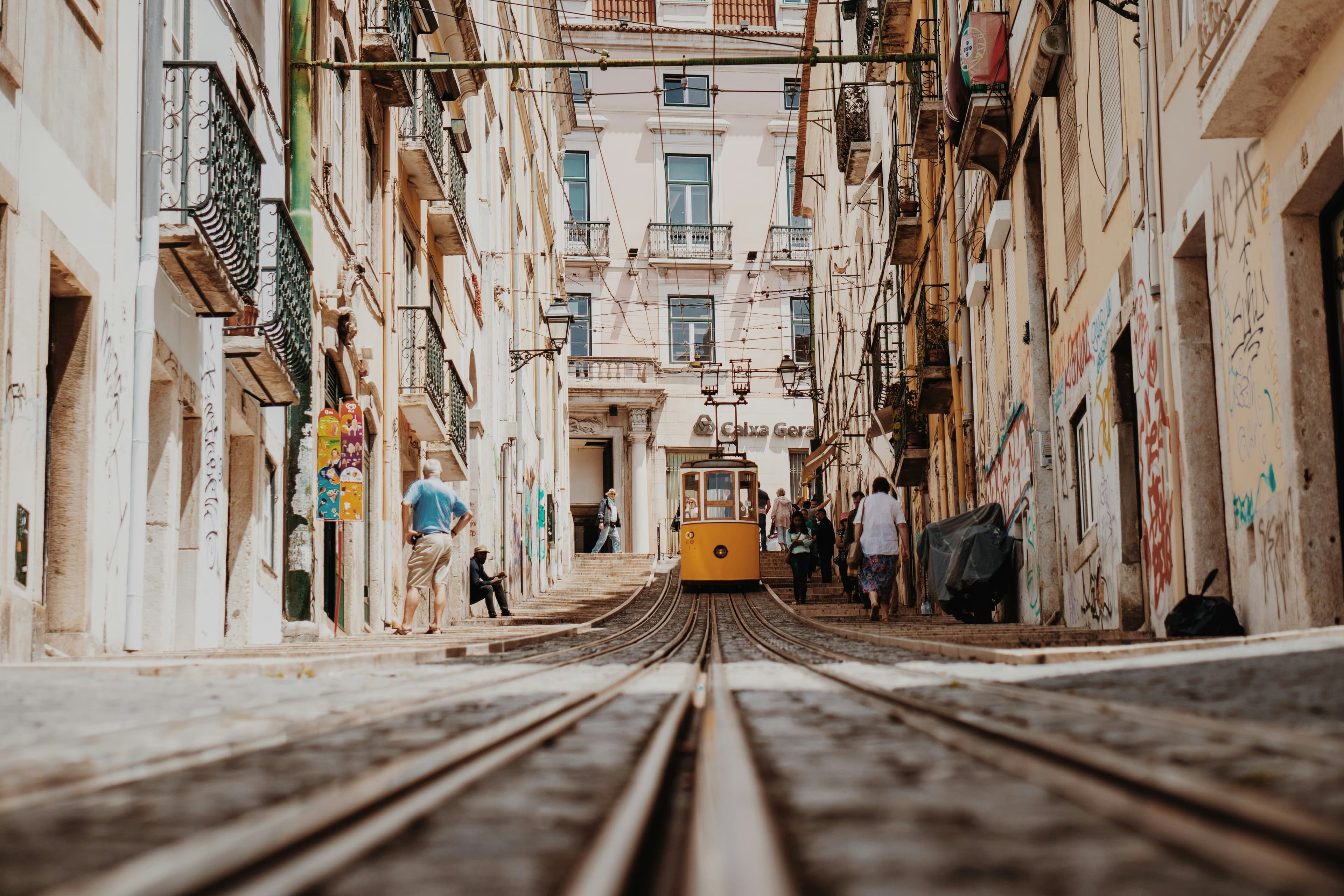
To experience Lisbon's smart city, do not look for a gleaming tech district. Instead, take the iconic Tram 28 as it rattles through the narrow streets of Alfama and Graça — and notice the subtle infrastructure changes along the route. Smart traffic management systems now coordinate the tram's passage with bus and metro schedules. Environmental sensors monitor air quality in the steep, enclosed streets where pollution can concentrate. And the GIRA bike-sharing stations clustered at key stops offer an alternative for the final kilometres of any journey.
Or visit the Beato Creative Hub, a former military bakery transformed into Lisbon's largest innovation campus, where startups, research labs, and creative studios share space in a riverside complex that embodies the city's approach to urban regeneration: reuse rather than demolish, mix rather than segregate, open rather than close.
Lisbon's relationship with technology is shaped by its character as a city of saudade — that untranslatable Portuguese longing for something beloved that is absent. Lisbon has lost population for decades as residents were pushed to the suburbs by rising costs and declining housing quality. The smart city programme, at its best, is an attempt to reverse that loss — to make the city liveable again for the people who remember what it was. When the Lisboa Inteligente app tells a resident where to park or when the next metro arrives, it is performing a small act of municipal care. When the circular economy strategy tries to reduce waste in the markets of Mouraria, it is preserving a neighbourhood's character whilst modernising its infrastructure. In Lisbon, the smart city is not about the future. It is about bringing back what was lost — and holding on to what remains.
References3 resources12 external
Resources

Organisation
Sensei
AI-powered autonomous retail enabling checkout‑free, frictionless shopping across urban stores using computer vision.

Organisation
Feedzai
AI-powered real-time fraud prevention platform securing digital payments for smart cities global

Organisation
Fábrica de Startups
Accelerates early-stage urban tech startups via mentorship, workspace, corporate partnerships, and investors.
External Sources
Lisboa Inteligente 2030 Strategynovaims.unl.ptLisboa Inteligente Platformlisboaaberta.cm-lisboa.ptLisbon's Circular Economy — URBACT Integrated Action Planurbact.euSmart Open Lisboasmartopenlisboa.comSmart Open Lisboa — Beta-i Project Overviewbeta-i.comSharing Cities — Lisbon Sitesmart-cities-marketplace.ec.europa.euSharing Cities — Lisbon Profilesharingcities.euLisbon Mobility Strategylisboa.ptPortugal Smart Cities Summit 2025ubiwhere.comPortugal Smart Cities Summit 2026 — EIT Urban Mobilityeiturbanmobility.euThe 2026 Sustainable Cities Summit — Participants Listlisboncouncil.netU!REKA Connects 2026 — Lisbonureka.eu